

Why Stretching Isn’t Fixing Your Tight Hip.
If your hips constantly feel tight no matter how much stretching you do, you are not alone.
Many people spend years foam rolling, stretching, doing yoga, or following mobility routines, only to find the tightness keeps returning.
The problem is that tightness is not always caused by a lack of flexibility.
In many cases, your body is creating tension for a reason.
At Functional Patterns Sunshine Coast, we often see people trying to stretch muscles that are already overworked, unstable, or compensating for deeper movement dysfunction.
Instead of simply asking, “What muscle feels tight?” we ask:
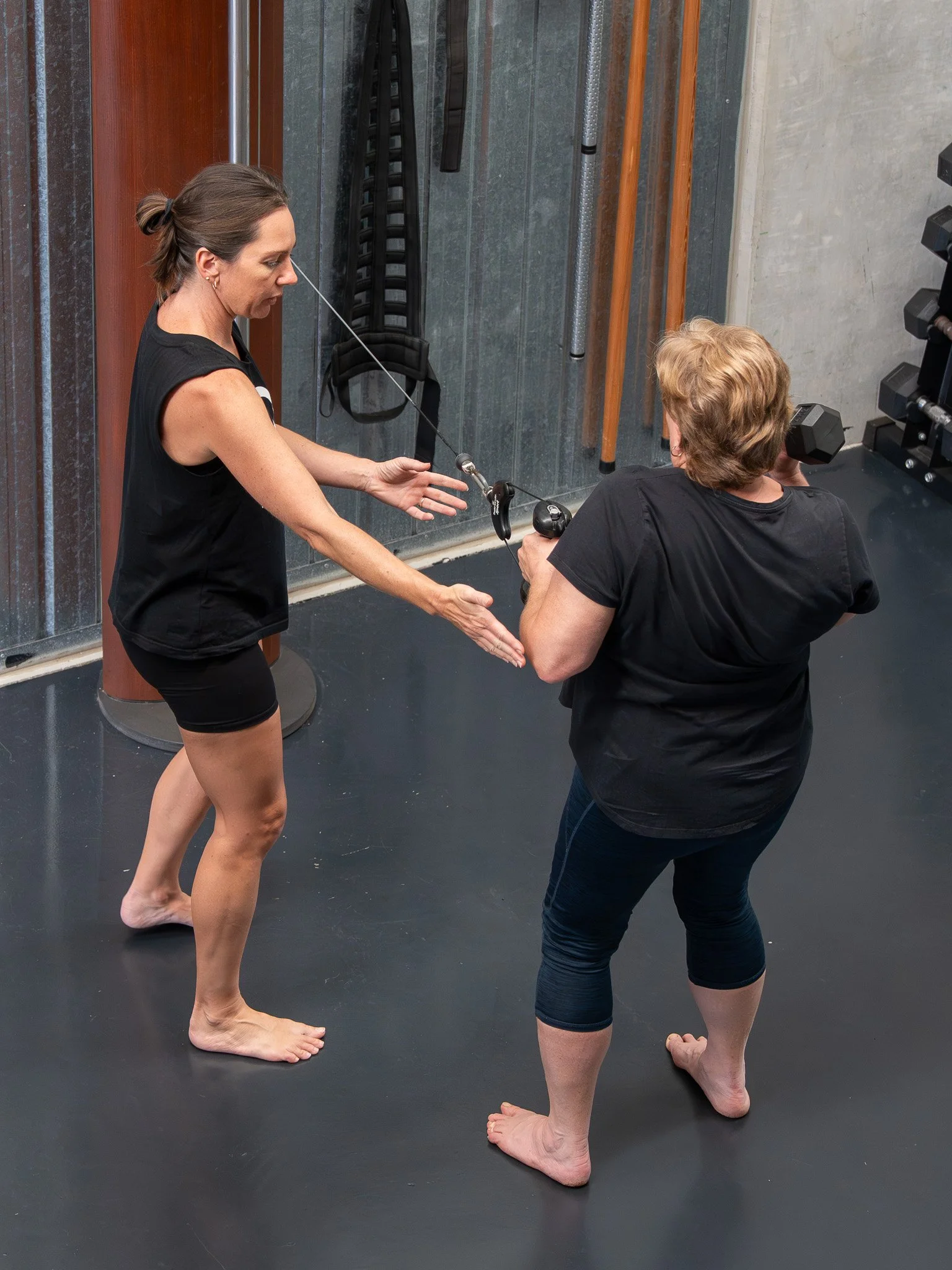
Why is the body creating tension there in the first place?
Tightness doesn’t always mean shortness.
One of the biggest misconceptions in fitness is that a tight muscle automatically needs to be stretched.
Sometimes a muscle feels tight because it is:
Overloaded or working overtime
Compensating for instability
Protecting a joint (e.g. spasm)
Hanging long (e.g. taut)
If the body does not feel stable, it often creates tension as a protective strategy.
That means aggressively stretching the area without addressing the underlying mechanics may only provide temporary relief, or can even make you more unstable.
This is why many people feel better immediately after stretching, only for the tightness to return shortly afterwards. It’s not problem solving and it’s not a long-term solution.
Your body adapts to repeated patterns
The body is constantly adapting to how you move.
If you spend most of your day:
Sitting
Walking with poor gait mechanics
Standing asymmetrically
Moving with poor rotational mechanics
Training around compensation patterns
…the body adapts accordingly.
Over time, certain muscles may become overactive while others become underutilised.
This can contribute to tight hips, but also can extend much further into this non-exhaustive list of issues):
Lower back tightness
Poor posture
Limited rotation
Knee discomfort
Hip pinching
Reduced mobility
Chronic stiffness
At Functional Patterns Sunshine Coast, we focus heavily on improving the body’s overall movement coordination rather than endlessly chasing symptoms.
Why Hip tightness often returns.
Many people repeatedly stretch the same areas for years:
Hip flexors
Piriformis
Hamstrings
Glutes
Lower back
Yet the tension keeps returning. But why?
Because the body is still operating with the same dysfunctional movement strategy - the patterning hasn’t changed.
If gait mechanics, posture, breathing, balance, and force distribution remain inefficient, the body reinforces the same tension patterns.
This is similar to repeatedly resetting a warning light without fixing the underlying issue.
The role of walking and gait mechanics.
One of the most overlooked contributors to chronic hip tightness is posture and gait - i.e. how you walk.
Walking is one of the most repeated movement patterns humans perform.
Every step reinforces a pattern.
If you walk with:
Poor pelvic control
Minimal thoracic rotation
Inefficient weight transfer
Excessive hip collapse
Poor foot mechanics
Reduced arm swing, and much more
…the hips may absorb stress inefficiently thousands of times per day.
This is one reason Functional Patterns places such a strong emphasis on gait retraining.
Rather than treating the hips in isolation, we look at how the entire body coordinates movement.
Mobility without stability can backfire.
Another common issue is chasing mobility without improving stability.
If the body gains range of motion without improving control, it may actually feel less secure.
This can lead the nervous system to create even more muscular tension.
In other words:
The body often prioritises stability over flexibility.
This is why improving:
Coordination
Posture
Weight transfer
Balance
Breathing mechanics
Rotational control
…can reduce tightness more effectively than stretching. And even more importantly, it actively works to address the drivers behind why your hips are tight to start with.
Why Functional Patterns Takes a Different approach.
At Functional Patterns Sunshine Coast, we do not simply chase symptoms.
We assess your specific:
Posture
Gait mechanics
Rotational movement
Balance and stability
Breathing mechanics
Force distribution
Compensation patterns
The goal is to help the body move more efficiently as an integrated system.
This often includes:
Gait retraining
Standing movement patterns
Rotational exercises
Integrated strength work
Coordination drills
Breathing integration
Targeted corrective exercises
Rather than forcing flexibility onto dysfunction, we aim to improve the body’s overall movement organisation. In the process, tightness fades away all while improving overall function.
Stretching isn’t inherently bad.
Stretching should be a byproduct of moving well.
In real-life, muscles get stretched as a byproduct of a muscle contraction, and so stretching done in the traditional way (absent of muscle contraction) only serves to disintegrate how the body should work together.
Therefore, without knowing how to move correctly, we don’t recommend attempting to stretch, as you’ll likely make your issues worse as it relates to function.
Without addressing the underlying mechanics, relief is temporary, and your problems become harder to truly solve.
Tight hips are a whole body issue.
Like everything in the body and nature, the hips do not function in isolation.
Hip function is heavily influenced by:
Rib cage positioning
Pelvic orientation
Foot mechanics
Thoracic rotation
Breathing patterns
Walking mechanics
Balance strategies
This is why focusing only on the local area misses the bigger picture.
At Functional Patterns, we work to improve how the entire body coordinates force rather than simply stretching isolated muscles.
Start addressing the system, not just the symptom.
If your hips constantly feel tight despite stretching, foam rolling, massage, or mobility work, it’s time to look deeper at how your body moves.
At Functional Patterns Sunshine Coast, we help people improve movement coordination through a personalised approach focused on biomechanics, posture, gait mechanics, and integrated human movement.
Ready to Get started?
The best place to begin is with a movement and posture assessment.
We analyse your individual:
Posture
Walking mechanics
Movement coordination
Compensation patterns
Balance and stability
Hip function
Overall movement efficiency
From there, we tailor every session to your individual needs and goals.
Whether you are dealing with chronic tightness, recurring pain, reduced mobility, or postural issues, our goal is to help your body move more efficiently long term.
Book an assessment
Hit the button below to request your initial consultation and start addressing your issues head on.
Frequently asked questions (FAQs)
-
Hip tightness is not always caused by a lack of flexibility. In many cases, the body creates tension as a response to instability, poor posture, inefficient gait mechanics, or compensation patterns.
-
In some situations, stretching unstable or overworked muscles without improving movement mechanics can increase irritation or fail to provide lasting relief. It’s chasing the symptoms, not addressing the system.
-
Chronic hip tightness is most often influenced by posture, sitting habits, gait mechanics, breathing patterns, pelvic orientation, compensation patterns, and inefficient force distribution throughout the body.
-
Yes. Walking is one of the most repeated movement patterns humans perform. Poor gait mechanics repeated thousands of times per day may contribute to hip tension, stiffness, and postural issues.
-
Not necessarily. Tightness can also be related to coordination, stability, nervous system tension, and inefficient movement patterns.
-
Functional Patterns is a training system focused on improving biomechanics, posture, gait mechanics, throwing patterns, rotational movement, and integrated human function. We fix symptoms by addressing the system.
-
Many people seek Functional Patterns training to improve posture, coordination, gait mechanics, mobility, and overall movement efficiency. Check out the results on our website and Instagram to see this in action.
-
Functional Patterns Sunshine Coast is located in Chevallum, Queensland and services the Noosa to Caloundra, Mooloolaba to Maleny region. They offer private training sessions, movement assessments, group training, online training and posture-focused training based on Functional Patterns principles.