

How Many Sets & Reps Should You Do?
why Functional Patterns Focuses on quality over quantity.
If you’ve spent any time in a commercial gym, you’ve probably heard endless advice about the “perfect” number of sets and reps.
3 sets of 10. 5x5. 12 reps for hypertrophy. Low reps for strength. High reps for endurance… etc, etc.
While these frameworks do have some value, they often miss a much more important question:
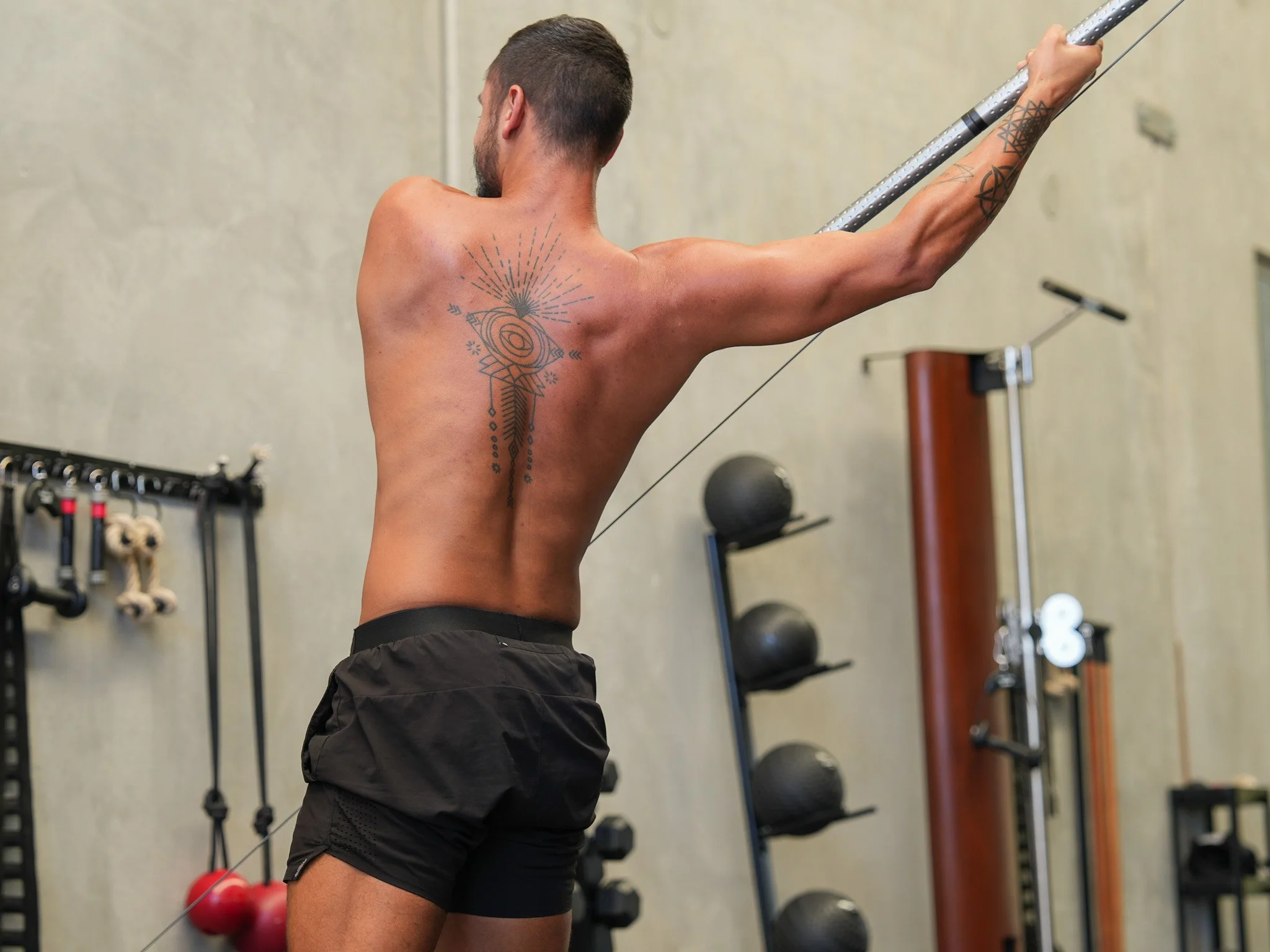
Can you actually coordinate the movement you’re repeating?
At Functional Patterns Sunshine Coast, we take a different approach to training.
Rather than chasing arbitrary training volume, we focus on improving the quality of human movement first - especially within the foundational movement patterns humans evolved around: i.e. STANDING, WALKING, RUNNING and THROWING.
These are functions have become known as “the FP first four.”
If your body cannot coordinate these patterns efficiently, adding more sets and reps to dysfunctional movement patterns may reinforce the very issues contributing to pain, stiffness, poor posture, inefficiency, or injury.
More Reps doesn’t necessarily mean better results.
In conventional fitness culture, hard work is often measured by volume.
More reps. More sets. More exhaustion. More sweat.
But the body adapts specifically to what it repeatedly does. You are what you repeat.
If you repeatedly move with poor mechanics, your body becomes more efficient at moving poorly.
This is one of the biggest reasons many people continue experiencing chronic tightness
Feel pain during exercise
Plateau despite training hard
Develop asymmetries
Struggle with posture
Feel stiff or unstable while walking or running
The nervous system does not simply recognise “effort.” It recognises patterns.
That means repetition without coordination can strengthen dysfunction just as easily as it can strengthen function.
You cannot train what you cannot coordinate.
One of the most important principles in Functional Patterns training is this:
You cannot meaningfully strengthen a pattern your body cannot coordinate properly.
For example, imagine someone performing lunges with:
Excessive pelvic rotation
Collapsed arches
Poor trunk control
Forward head posture
Poor weight transfer
Adding heavier loads or increasing repetitions may increase effort, but it does not necessarily improve efficient function.
In many cases, it simply reinforces compensation patterns.
At Functional Patterns Sunshine Coast, we prioritise movement quality before movement quantity.
That means slowing movements down, refining mechanics, improving sequencing, and teaching the body how to distribute force more effectively.
The Problem with Arbitrary sets and reps.
Many training programs prescribe volume without considering the individual.
For example: “Do 4 sets of 12”, “Perform 100 repetitions” or “Train to failure”
But two people can perform the exact same workout with completely different outcomes depending on:
Posture
Coordination
Injury history
Gait mechanics
Breathing patterns
Rib cage and pelvic orientation
Balance and stability
Joint loading strategies
The number itself is often far less important than how the movement is being performed.
Someone with efficient mechanics may tolerate higher volumes well.
Someone with dysfunctional movement patterns may become increasingly compressed, unstable, or irritated with the exact same prescription.
This is why Functional Patterns training does not revolve around chasing volume for its own sake.
Why the ‘FP First Four’ matter.
Walking and running are the most repeated movement patterns humans perform.
Every step reinforces a pattern.
If your gait mechanics are inefficient, you may accumulate thousands of dysfunctional repetitions every single day.
This is why improving gait mechanics is such a major focus within Functional Patterns.
The goal is not simply to “exercise more.”
The goal is to help organise the body to move more efficiently during the movements it performs most often.
When gait improves, people often notice improvements in:
Posture
Balance
Joint discomfort
Hip mobility
Spinal rotation
Breathing efficiency
Coordination
Athletic performance
Energy expenditure
Rather than separating training from real-world movement, Functional Patterns bridges the gap between the gym and human function.
Dysfunction repeated is still dysfunction.
A common misconception in fitness is that repetition automatically creates mastery.
But repetition only strengthens whatever pattern is being repeated.
If the pattern itself is dysfunctional, more repetition can deepen the problem.
For example:
Repeatedly squatting with poor spinal mechanics
Running with excessive collapse through the hips
Training upper body movements with poor scapular control
Walking with minimal thoracic rotation
Over time, the body adapts to these inefficient strategies.
This may contribute to chronic overuse, joint stress, muscular imbalances, and compensatory movement patterns.
This is why Functional Patterns practitioners place such a strong emphasis on awareness, coordination, and mechanics.
What Functional Patterns Looks at Instead.
Instead of asking: “How many reps should I do?”
We often ask: “How well can you perform the movement?” (and does the movement matter that much).
At Functional Patterns Sunshine Coast, training is often guided by factors such as:
Mechanical efficiency
Coordination
Rotational integrity
Weight transfer
Breathing mechanics
Balance and posture
Gait quality
Force distribution
This often means using:
Lower volumes initially
Slower tempos
More controlled movements
Targeted corrective exercises
Integrated standing patterns
Multi-planar movement training
The aim is not simply to tire the body out.
The aim is to improve how the body organises movement.
SO how many set and reps should i actually do?
The honest answer is:
It depends on the quality of your movement.
In Functional Patterns training, there is no universal number that applies to everyone.
Sometimes fewer repetitions performed with precision produce far better long-term results than high-volume training done with poor mechanics.
In many cases, quality decreases as fatigue increases.
That means stopping a set before mechanics deteriorate may actually be more beneficial than pushing through endless repetitions.
This approach can be particularly important for people dealing with:
Chronic pain
Poor posture
Recurring injuries
Tight hips or shoulders
Low back discomfort
Running inefficiencies
Joint instability
Movement asymmetries
Rather than forcing volume onto dysfunction, we aim to progressively improve the body’s ability to coordinate movement under increasing demand.
Functional Training Should improve Real-Life Function.
At its core, Functional Patterns training is designed to improve human function.
That means training should carry over into: walking, running, standing, rotating, reaching, carrying, reacting to force and moving efficiently through everyday life
A training program that builds strength while simultaneously reinforcing dysfunctional movement patterns cannot improve efficient function sustainably.
This is why we emphasise movement quality so heavily.
The better your body coordinates movement, the better it can absorb force, transfer energy, and operate efficiently.
Quality first. Volume Second.
Volume has its place. But in Functional Patterns, volume is earned through improved coordination.
Once movement quality improves, the body is often better equipped to tolerate:
Higher workloads
Greater intensity
Faster movement
More complex patterns
Increased athletic demand
Trying to skip straight to volume without first improving mechanics is often where problems begin and is often people get ‘stuck’.
Start Improving your movement patterns.
If you are constantly dealing with stiffness, recurring pain, poor posture, inefficient running mechanics, or training plateaus, it may not be a matter of simply doing more sets and reps.
It may be a matter of improving the quality of the movement patterns you repeat every day.
At Functional Patterns Sunshine Coast, we help people improve movement coordination through a personalised approach focused on biomechanics, posture, gait mechanics, and integrated human movement.
Ready to get started?
The best place to begin is with a movement and posture assessment.
We analyse:
Posture
Walking mechanics
Running mechanics
Movement coordination
Compensation patterns
Balance and stability
Overall movement efficiency
From there, we tailor every session to your individual needs and goals.
Whether you are dealing with pain, trying to improve athletic performance, or simply wanting to move better long term, our goal is to help your body function more efficiently.
Book an initial consultation.
Hit the button below to learn more or contact our team to get started.
Frequently asked questions (FAQs)
-
DescriptThere is no universal number that applies to everyone. Functional Patterns training focuses more heavily on movement quality, coordination, posture, and biomechanics than arbitrary training volume. The ideal number of sets and reps depends on how efficiently you can perform the movement.
-
Walking and running are among the most repeated movement patterns humans perform. Dysfunctional gait mechanics repeated thousands of times can contribute to inefficient movement patterns, joint stress, and postural issues over time.
-
Not necessarily. More exercise performed with poor mechanics can actually reinforce dysfunctional movement patterns. In many cases, improving coordination and movement efficiency is more beneficial than simply increasing volume.
-
Poor force distribution, inefficient gait mechanics, compensation patterns, and joint instability may contribute to pain and chronic tightness. Functional Patterns aims to improve how the body organises movement to reduce unnecessary stress on tissues.
-
Functional Patterns places a strong emphasis on biomechanics, gait mechanics, posture, rotational movement, and integrated full-body coordination. I.e. It focus on improving the movements that actually matter. Rather than isolating muscles, the system focuses on improving how the body functions as a connected system.
-
Many people seek Functional Patterns training to improve posture, coordination, gait mechanics, and overall movement efficiency. Training often focuses on improving alignment, balance, rotational mechanics, and weight distribution.
-
Functional Patterns can benefit athletes by improving coordination, force transfer, gait efficiency, rotational mechanics, and movement economy. Better movement efficiency may help improve performance while reducing unnecessary stress on the body. For these reasons, it’s also excellent for rehabbing people out of injury and chronic pain.
-
Functional Patterns Sunshine Coast is located in Chevallum on the Sunshine Coast and offers one-on-one sessions, group training, posture assessments, and movement-focused training based on Functional Patterns principles. We serve clients from Buderim, Noosa, Caloundra, Mooloolaba, Caboolture, and everywhere in between.