

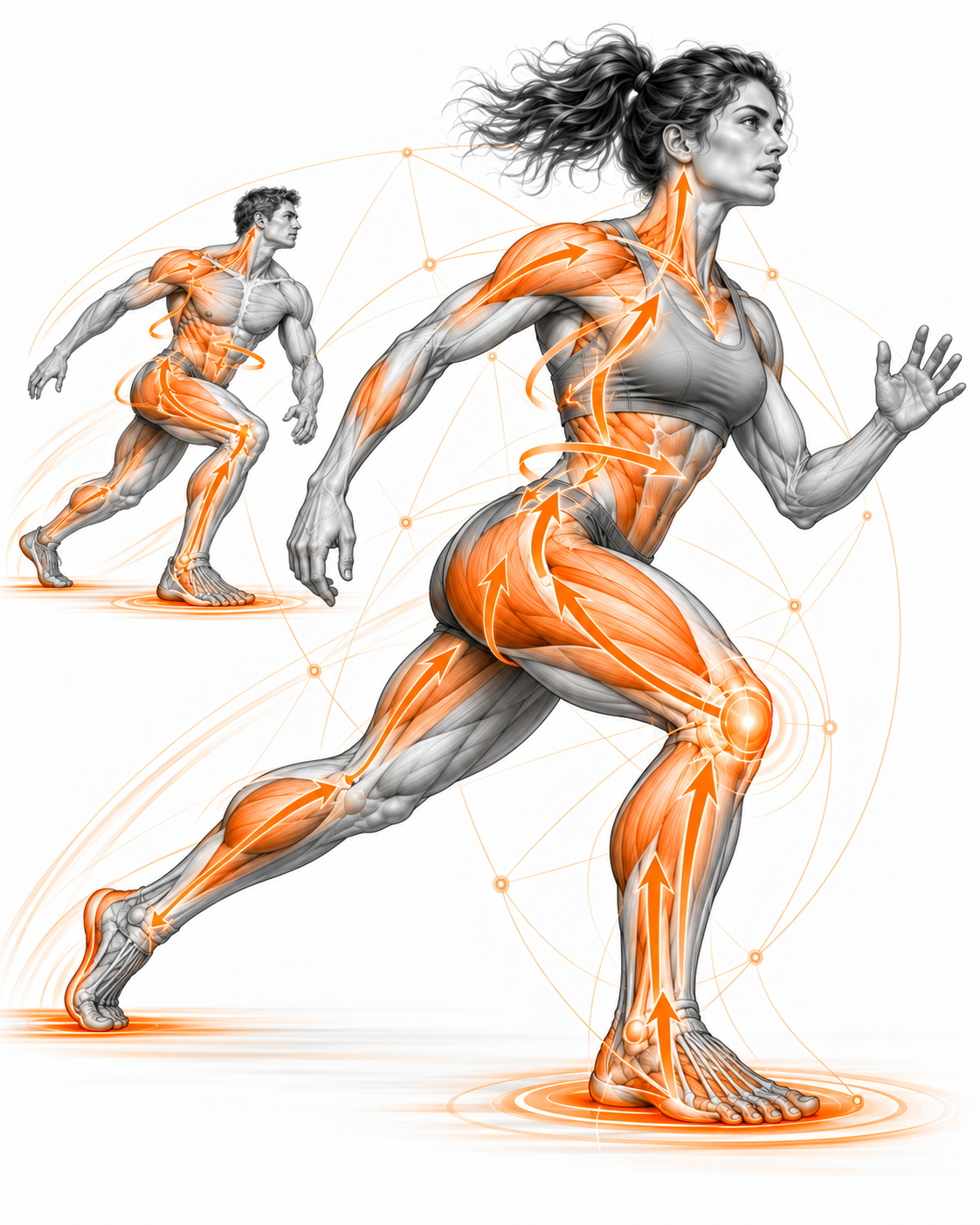
The body is one continuous, connected structure,
Knee pain is felt at the knee, but understanding why it develops can require looking much further than the joint itself.
If your knee hurts when you walk, run, squat, climb stairs or exercise, it is natural to focus on the knee. It is where you feel the discomfort, and it is often where you instinctively direct your efforts to improve it. But movement is not produced by individual joints working independently.
Every step, squat or change of direction involves a coordinated interaction between your feet, ankles, knees, hips, pelvis and trunk. These structures have to work together to manage body weight, generate force, absorb impact and transfer momentum.
The knee is an important part of that process. It also has its own muscles, tendons, ligaments, cartilage and other structures that can be injured or become painful.
The more useful question, therefore, is not simply whether your knee is strong enough. It is whether the knee and the rest of your body are managing the demands being placed on them, and whether the capacity of the relevant tissues matches those demands. At Functional Patterns Sunshine Coast, this broader perspective is central to how we think about movement.
The knee doesn't work in isolation.
Consider what happens when you walk. As your foot makes contact with the ground, your body needs to manage the force created by that contact. Your ankle, knee and hip all contribute to controlling the movement of your body over the supporting leg. Your pelvis and trunk also influence how your centre of mass moves and how forces are transferred through your body.
The knee is therefore doing more than simply bending and straightening. It is participating in a coordinated task that involves the entire body. The same principle applies when you climb stairs, run, squat or change direction. The amount of demand placed on the knee can be influenced by several interacting factors, including:
The speed and direction of movement.
How much force is being produced or absorbed.
The position and movement of the foot, ankle, hip and pelvis.
The timing and coordination of different body segments.
The strength and capacity of the muscles and other tissues involved.
How frequently the movement is repeated and how much recovery is available.
This doesn't mean that every knee problem originates somewhere else. It means that examining the knee without considering the task it is performing and its relationship with the rest of the body, can leave important information out of the picture.
How movement changes the demands placed on your knee.
Imagine two people performing the same movement, such as stepping down from a low platform. Both people complete the task, but they may organise their bodies quite differently.
One person may distribute the movement across the ankle, knee and hip, with their trunk and pelvis contributing to balance and control. The other may use a more restricted strategy, relying heavily on a smaller range of movement at the knee or shifting their body position in a way that changes where the demand is concentrated.
Neither observation automatically tells us that one person will experience pain and the other won't. Movement cannot be judged reliably from a single visual feature. However, it gives us something important to investigate: how is the person organising their body to complete the task, and where is the physical demand being managed?
Joint position, movement direction, muscle activity and coordination all influence the forces acting around a joint. Changes in one area can alter the contribution required from another. For example, a limitation in ankle movement may change how someone approaches a squat or step-down. Differences in hip control or trunk position may also influence the movement strategy.
These are not diagnoses in themselves. They are potential contributors that need to be considered alongside the knee's own condition, strength, tissue capacity and symptom response. The aim is not to find one faulty joint position. It is to understand the movement strategy as a whole.
Your body becomes practised at the movements you repeat.
One of the most important ideas in biomechanics is that the body adapts to the demands placed upon it. Movement is not something you simply perform and then forget. Every time you walk, run, squat or climb stairs, your nervous system and musculoskeletal system are responding to a particular set of demands. Repeated often enough, movement strategies become familiar and increasingly practised.
This adaptation can be useful. It allows you to become more capable at the activities you perform regularly. But the same principle applies when a movement strategy is restricted, poorly coordinated or consistently places a high demand on particular tissues. A compensation can initially be a useful way of maintaining movement when something is painful, weak or limited. The concern is not that compensation exists. It is whether a particular strategy becomes the default and continues to be reinforced when it is no longer serving you well.
For someone with recurring knee pain, this raises an important question: Are the activities and movement behaviours being repeated each week helping build the capacity and coordination needed for the demands of daily life, or are they continually reinforcing a strategy that may be contributing to the problem?
This is one reason why looking at someone's movement outside the exercise session can be valuable. A person might train twice a week, but their body is also responding to thousands of steps, hours of sitting, work demands, recreational activities and other repeated behaviours. The broader pattern matters.
Is strengthening your knee enough?
Strength is an important part of knee function. The muscles around the knee contribute to producing and controlling movement, and appropriately prescribed strengthening is a well-supported component of care for many common knee conditions. However, strength and movement coordination are not interchangeable.
Being able to produce more force in a controlled exercise does not automatically mean that you can organise that force effectively while walking, running, changing direction or managing an unexpected movement. Consider the difference between a seated knee extension and walking.
A knee extension primarily trains the knee to produce force against a particular resistance. Walking requires the body to coordinate multiple joints and body segments while managing changing forces, balance and forward progression. Both activities can have value. They simply involve different demands.
This is why a useful approach should not dismiss local knee strengthening, but should also consider how strength is integrated into the movements a person actually needs to perform. The question becomes broader than how strong the knee is. It becomes how effectively the body can use its available strength and capacity in real movement.
Why repeated activity and training load matter.
Even a well-coordinated movement can become difficult to tolerate when the demands exceed the body's current capacity. This is particularly relevant when someone increases their running distance, training frequency, intensity or time spent on their feet.
A change in training load can increase the amount of work required from the knee and surrounding structures. If that increase is greater than the person is currently prepared to manage, symptoms may develop or become more noticeable. This is not necessarily evidence of poor movement. Nor does it mean that the knee is damaged every time it becomes painful.
It means that load, recovery and capacity need to be considered together. When knee pain appears, it can be useful to look at what has changed recently:
Have you increased your running distance or frequency?
Have you introduced hills, faster sessions or more demanding terrain?
Have you returned to exercise after a period of reduced activity?
Have you increased the amount of squatting, lunging or stair climbing?
Are you recovering adequately between demanding sessions?
These questions help establish the context in which the symptoms developed. In some situations, temporarily modifying the amount or type of activity is sensible. In others, maintaining activity with appropriate adjustments may be more suitable.
The objective is not to avoid loading the knee indefinitely. It is to find a level of demand that can be managed while progressively developing the capacity required for the activities that matter to you.
What should actually be assessed?
Knee pain can arise from a range of conditions, including patellofemoral pain, tendon problems, ligament injuries, meniscal injuries and osteoarthritis. These conditions are not interchangeable, and an appropriate assessment needs to consider the person's history, symptoms and clinical presentation.
A whole-body movement assessment adds another layer of information. It looks at how the person manages the tasks that matter to them, rather than assuming that the painful joint tells the whole story. Depending on the person's presentation, relevant observations may include:
1. Standing and posture
How does the person organise their body when standing? What positions do they habitually use, and how do they manage their weight and balance?
2. Walking mechanics
How does the person transfer weight from one leg to the other? How do the foot, ankle, knee, hip, pelvis and trunk coordinate during each step?
3. Squatting and stepping
How does the person manage changes in knee and hip flexion? Where does movement occur, and how is the task controlled?
4. Running mechanics
Where relevant, how does the person manage repeated ground contact, forward progression, speed and changes in running demand?
5. Coordination and force transfer
How effectively do the upper and lower body contribute to movement? Are different areas working together, or is the person relying heavily on a limited movement strategy?
These observations are not a substitute for a medical or clinical assessment of the knee itself. They help build a broader picture of how the person moves and where changes may be worth investigating. Importantly, the findings need to be interpreted in context. A particular posture or movement pattern does not, by itself, prove the cause of someone's pain.
How Functional Patterns approaches knee pain.
At Functional Patterns Sunshine Coast, we use a whole-body biomechanics framework to understand how people organise their movement. Rather than automatically treating the painful area as the entire problem, we look at how the body functions as an integrated system.
Our reference points include the FP First Four: standing, walking, running and throwing. These fundamental human movements provide a framework for examining posture, coordination, sequencing and the way force is transferred throughout the body.
The aim is not to make every person move like an elite athlete. It is to use these fundamental patterns to help identify limitations in an individual's movement and establish a direction for improvement. Our process follows four stages:
Identify
Understand the person's history, goals, movement behaviours and current limitations. This includes observing how they manage relevant movement tasks.
Reposition
Work towards improving joint positioning, stability and coordination so that the body has more options available when completing a movement.
Reinforce
Practise the improved movement strategy consistently, building the coordination and physical capacity needed to use it more effectively.
Adapt
Progressively expose the body to greater movement demands so that improvements can transfer into more complex and demanding activities.
The process is individual. Someone with an acute knee injury will have different needs from someone with years of recurring discomfort, and both require appropriate consideration of the knee itself. In some cases, it may also be appropriate to temporarily reduce an activity that is repeatedly reinforcing a movement strategy being addressed. This is not a blanket instruction to stop exercising. It is a targeted decision based on the person's assessment, current capacity and goals.
The longer-term objective is not simply to avoid the movements that cause discomfort. It is to develop the movement capacity to participate in the activities that matter.
What if your knee pain keeps returning?
Recurring knee pain can be frustrating, particularly when you have already tried strengthening, stretching, resting or changing your exercise routine. If your symptoms keep returning, it may be worth reconsidering the bigger picture.
Are you addressing the specific demands that trigger your symptoms? Has your training load progressed appropriately? Is your knee developing the capacity it needs? Are there movement behaviours elsewhere in your body that deserve closer attention?
These questions can help move the conversation beyond simply finding another exercise for the knee.
The goal is to understand what your body is being asked to do, how it is currently managing those demands, and what needs to change to improve your capacity over time.
Ready to Get Started?
An initial consultation at Functional Patterns Sunshine Coast looks at your movement as an integrated system, taking into account your history, goals, posture, walking mechanics and other relevant movement behaviours. This helps identify potential limitations and establish a starting point for working towards better movement and function.
If you're experiencing recurring knee pain and want to understand how your body is managing movement, click below to request your initial consultation.
Frequently asked questions
-
Yes. It can be influenced by factors beyond the knee, including movement at the ankle, hip and trunk. However, knee pain can also arise from conditions specific to the knee. An individual assessment is needed to understand which factors are relevant.
-
Not necessarily. The appropriate response depends on the cause, severity and behaviour of your symptoms. Some activities may need to be temporarily modified, while others can often be continued with suitable adjustments. Significant or worsening symptoms should be assessed by an appropriate health professional. What’s likely more important is what your exercise is promoting in your body - more functional adaptation, or less.
-
Yes. Hip and ankle mechanics can influence how forces are distributed through the lower limb. In some presentations, changes in hip control, ankle mobility or foot function may contribute to the mechanical demands experienced at the knee. However, knee pain has many possible causes and requires an individual assessment.
-
Hip muscle strength and function can influence lower-limb movement, and hip-targeted exercise may be useful for some people with knee pain. However, weak glutes are not a universal explanation for knee pain. The relationship needs to be considered alongside the knee, foot, ankle, spine, chest and overall movement demands.
-
Quadriceps strengthening is useful for many knee conditions, but it may not address every factor contributing to someone's symptoms. Depending on the presentation, an appropriate plan may also consider hip strength, movement coordination, training load and the specific demands of daily activities.
-
Yes. Functional Patterns Sunshine Coast uses a whole-body biomechanics approach to examine movement, posture, coordination and the demands placed on the body. In doing so, we are considering the knee in the wider context of it’s relationship with the rest of the body.
-
Functional Patterns Sunshine Coast operates from Suite 10, 68–72 Empire Crescent, Chevallum, Queensland. We offer individualised training by appointment and work with clients all a wide variety of conditions across the entire Sunshine Coast.