

Scoliosis: Why the Spine Should Be Viewed as Part of a Whole-Body Movement System.
Quick Answer: Can Scoliosis Be Improved Through EXERCISE & Better Movement?
Scoliosis is more than a sideways curvature of the spine. It involves three-dimensional changes in spinal alignment that can influence posture, balance, and movement throughout the body. Rather than focusing solely on the spine, a whole-body approach considers how the pelvis, rib cage, limbs, and movement patterns interact. By improving biomechanics and addressing inefficient movement habits, it may be possible to improve functional capacity, muscular coordination, and postural control, while reducing associated discomfort. However, changes in spinal curvature are not guaranteed and depend on the individual. Exercise can help people with scoliosis improve strength, movement, coordination, posture, physical capacity and often symptoms such as back pain. The appropriate approach depends on the person's age, curve type, severity, symptoms and medical history.
READ MORE:
Scoliosis is commonly described as a sideways curvature of the spine. But scoliosis is more than simply a spine that “bends to one side”.
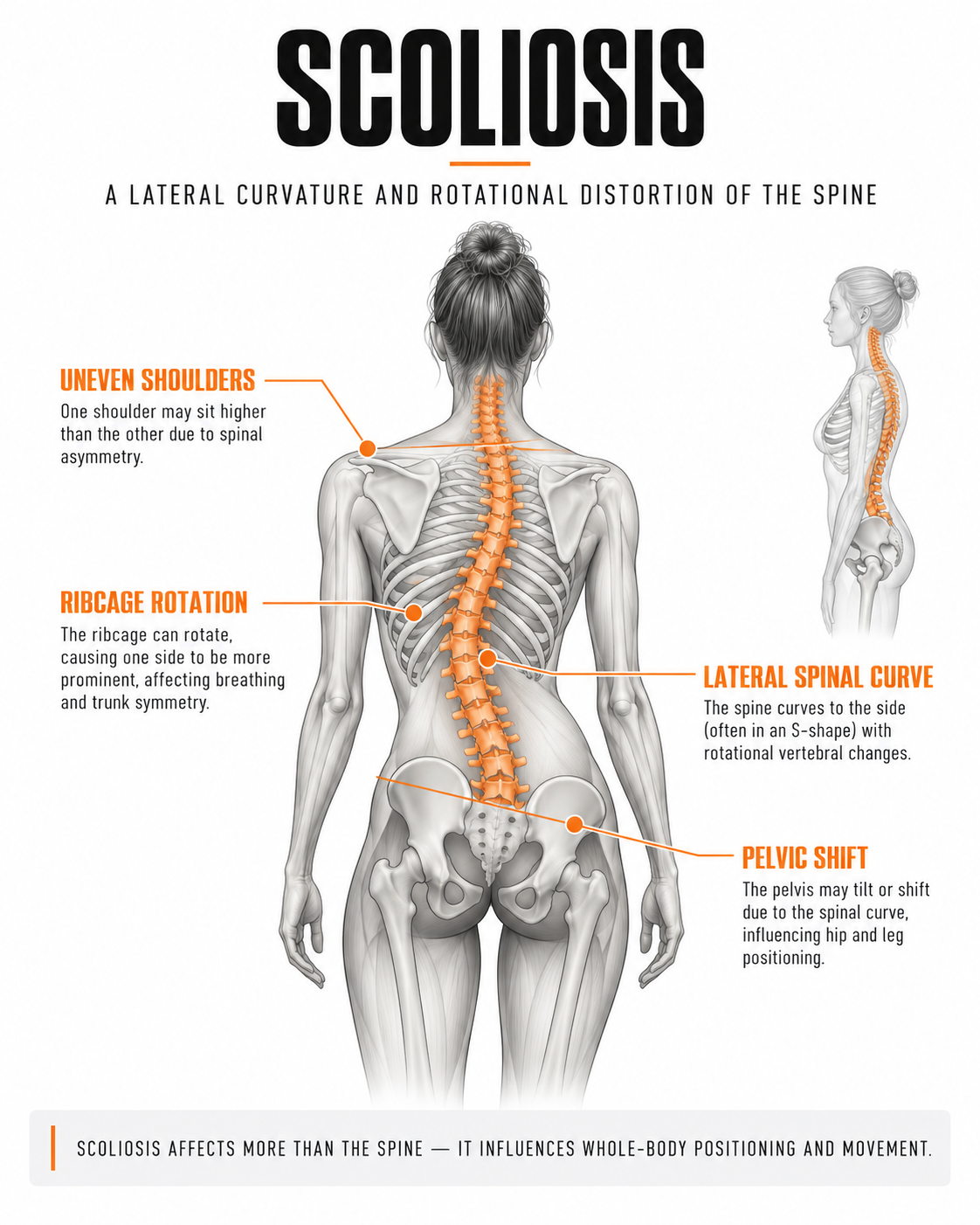
A scoliosis involves three-dimensional changes in the way the spine and trunk are organised, often including rotation, asymmetry through the ribcage, differences in shoulder or hip height, and changes in how the body distributes weight.
So when it comes to exercise, an important question is not simply:
“How do we straighten the spine?”
It is:
“How does this person's entire body move, distribute force and compensate around their scoliosis?”
At Functional Patterns Sunshine Coast, that broader question shapes how we approach training.
What Is Scoliosis?
Scoliosis is a condition in which the spine curves sideways and rotates. It can occur at any age, although adolescent idiopathic scoliosis - scoliosis without a known underlying cause that develops during growth - is one of the most common forms. Other forms include congenital, neuromuscular and degenerative scoliosis.
Common physical signs can include:
uneven shoulders
one shoulder blade appearing more prominent
uneven waist or hips
the trunk shifting to one side
rib prominence on one side
a visibly curved spine.
Is Scoliosis Just a Problem With the Spine?
No part of the body functions independently. Your spine connects the pelvis to the ribcage. Your ribcage interacts with your shoulders and arms. Your pelvis interacts with your hips and legs. And all of those structures have to coordinate while you stand, walk, breathe, rotate and move.
The body does not move as separate muscles or isolated joints — it functions as one interconnected system.
With scoliosis, this becomes especially relevant. A visible spinal curve may coexist with asymmetries in:
pelvic positioning
ribcage orientation
shoulder position
hip mechanics
weight distribution
trunk rotation
gait
breathing mechanics
Rather than looking at the spine in isolation, we therefore want to understand how the entire body is organising movement around that spinal shape.
Why Does Scoliosis Affect More Than Just Posture?
Because posture influences movement — and movement influences where force goes. When one part of the body changes position, the rest of the body must respond.
For example, rotation through the spine can influence:
ribcage position → shoulder position → pelvic orientation → hip mechanics → weight transfer
The body then finds ways to keep you upright and moving. Those strategies are compensations. Compensation is not automatically bad. In fact, compensations often allow the body to keep functioning when there is asymmetry, restriction, injury or structural change. The problem occurs when a movement strategy becomes inefficient, repetitive and limiting. Your body continuously adapts to what it repeatedly experiences.
Why Movement Strategy Matters With Scoliosis
Two people can both have scoliosis and move very differently. One may shift heavily onto one leg. Another may struggle to rotate their ribcage. Another may have limited hip movement. Another may appear relatively symmetrical during walking despite having a clear spinal curve.
So the diagnosis alone does not tell us exactly what to train. We need to look at the individual. At Functional Patterns Sunshine Coast, we are interested in questions such as:
How is weight transferred between the left and right sides?
How does the pelvis rotate?
How does the ribcage counter-rotate?
Can both sides of the body accept and produce force?
How do the arms and legs coordinate with the trunk?
Does the body have movement options, or is one compensation dominating?
What happens during walking rather than only during standing?
This is where scoliosis becomes a movement problem as well as a structural description.
Can You Improve Posture if You Have Scoliosis?
Yes, posture and movement can often change even if a structural spinal curve remains. This is another distinction worth making very clearly. Improving posture does not necessarily mean completely straightening the spine. It may mean improving:
how the pelvis and ribcage relate to one another
shoulder symmetry
weight distribution
rotational control
trunk organisation
breathing
movement confidence
overall physical capacity
Why We Don't Just Train the Side That Looks “Weak”.
A common approach to asymmetry is: “This side looks weak, so strengthen it.” Or: “This side looks tight, so stretch it.” But appearance alone does not tell us the whole movement strategy. The booklet makes the same point more broadly: weakness and tightness can be expressions of a movement dysfunction rather than the root cause itself.
With scoliosis, this is particularly important. A muscle may appear shortened because of the position of the ribcage. Another may appear weak because the joint positions underneath it do not allow it to contribute effectively. So instead of automatically chasing individual muscles, we ask:
How is the whole system organising force?
Tensegrity and Scoliosis: Thinking Beyond the Spine
Your body is not a stack of independent bones held together by isolated muscles. It is a connected structure. The position and tension of one part influence what happens elsewhere.
We describe two useful ideas:
Tensegrity:
The muscles, fascia, joints and other tissues act as an interconnected network.
Joint positioning:
The position of the joints influences the pathway force takes through that network. In someone with scoliosis, these relationships are rarely symmetrical. Our aim isn't to force every structure into an artificially symmetrical position. It is to improve how efficiently the body manages force within the structure that person has.
What Does Walking Have to Do With Scoliosis?
Quite a lot. Walking is one of the highest-volume movements we perform. Every step requires coordinated motion between:
the feet
hips
pelvis
spine
ribcage
shoulders
arms
The body must transfer weight from one side to the other while rotating and counter-rotating. If one strategy repeatedly dominates, the body receives thousands of repetitions of that same pattern every day.
“Movement is a behaviour learned through repetition, and the body becomes increasingly efficient at whatever movement behaviours it repeatedly practises”
This is why we don't necessarily view scoliosis training as a collection of isolated spinal exercises. We also look at the movement patterns the person repeats throughout everyday life.
The FP First Four and Scoliosis.
Within Functional Patterns, we prioritise four fundamental human movement patterns:
Standing. Walking. Running. Throwing.
These are called the FP First Four. They give us a functional reference point for understanding how the whole body coordinates movement. The goal isn't to make someone with scoliosis move exactly like somebody without scoliosis. Nor is it to assume that every asymmetry must disappear. Instead, we use efficient human movement as a reference point and ask:
Can this person distribute force more effectively?
Can they rotate more efficiently?
Can more of their body participate?
Can overloaded areas do less work while previously underused areas contribute more?
That is much closer to what we're trying to achieve.
How We Approach Training Someone With Scoliosis.
1. Identify
We first assess how the person stands and moves. This may include looking at:
spinal and ribcage asymmetry
pelvic position
weight distribution
walking mechanics
trunk rotation
shoulder movement
hip mechanics
coordination
symptoms and movement history
For someone with diagnosed scoliosis, medical imaging and specialist findings are also useful context.
2. Reposition
We work to create positions where the body can distribute force more effectively. This may involve changes through the:
feet
hips
pelvis
ribcage
shoulders
spine
rather than trying to directly “straighten” the spine.
3. Reinforce
Better movement needs repetition. Once a more efficient strategy is available, it has to be repeatedly practised, loaded and integrated into more complex movement.
4. Adapt
With enough appropriate repetition, the nervous system becomes more familiar with the new movement strategy
What Are the Goals of Scoliosis Training?
The goals can include:
improving movement efficiency
improving weight distribution
improving posture
improving coordination
increasing strength within better movement patterns
improving walking mechanics
improving breathing mechanics
reducing unnecessary stress on overloaded regions
increasing confidence and physical capacity
helping manage pain where pain is present
For some people, visible posture often also changes.
Have Scoliosis and Want to Understand How Your Body Moves Around It?
At Functional Patterns Sunshine Coast, we assess more than the shape of your spine. We look at how your entire body stands, walks, rotates and distributes force — then build an individual movement plan based on what we find.
Biomechanics-based training for scoliosis, posture, pain and movement on the Sunshine Coast.
FREQUENTLY ASKED QUESTIONS
-
Exercise can make significant improvements to movement, strength, posture, coordination and symptoms. At Functional Patterns, we showcase evidence of reversing the curves of scoliosis.
-
Often postural and functional asymmetries may improve without surgery. Though progress of treatment depends on the person's age, curve severity and clinical situation.
-
There is no single best exercise for everyone with scoliosis. The appropriate exercise has to address the problem as one entire system. What exact exercises are best for your, depends on the person's curve, movement strategy, symptoms, age and goals and underlying movement defecits.
FAQ
These questions are particularly useful for AEO.
Can scoliosis be corrected with exercise?
Exercise can improve movement, strength, posture, coordination and symptoms in some people, but it should not be presented as a guaranteed way to completely reverse a structural scoliosis.
Can you straighten scoliosis without surgery?
Some postural and functional asymmetries may improve without surgery, but a structural scoliosis cannot be assumed to fully straighten through exercise alone. Treatment depends on the person's age, curve severity and clinical situation.
What exercise is best for scoliosis?
There is no single best exercise for everyone with scoliosis. The appropriate exercise depends on the person's curve, movement strategy, symptoms, age and goals.
Is walking good for scoliosis?
Walking is generally a useful form of physical activity and is not normally avoided simply because someone has scoliosis. From a biomechanics perspective, the quality of walking mechanics can also be worth assessing because walking is repeated thousands of times every day.
Can scoliosis get worse with age?
It can in some people. The likelihood depends on factors including the type and magnitude of the curve, growth status in younger people and degenerative changes in adults. Anyone concerned about progression should be medically assessed.
Does scoliosis cause uneven hips?
It can be associated with visible differences in hip, waist, shoulder or ribcage position, although these asymmetries vary considerably between individuals.
Does scoliosis always cause pain?
No. Some people with scoliosis have pain and others have little or none.
Is scoliosis caused by bad posture?
Idiopathic scoliosis is not considered to be caused by ordinary bad posture. Its cause is often unknown. nhs.uk
Can Functional Patterns help scoliosis?
Functional Patterns training can be used to work on movement efficiency, posture, coordination, strength and force distribution in people with scoliosis. The degree of change will vary from person to person, and training should not replace appropriate medical assessment or treatment where required.