

How to Fix Forward Head Posture: Why Your Head Position Is Usually a Whole-Body Problem.
Quick Answer: How Do You Fix Forward Head Posture?
Forward head posture is best addressed by identifying why the head is being positioned forward, rather than simply stretching the neck or pulling the chin back. In many cases, the position reflects a whole-body movement strategy involving the ribcage, pelvis, spine and shoulders. Improving joint positioning, weight transfer, rotation and coordination — then repeatedly reinforcing that improved movement — can allow posture to change more naturally over time.
Forward Head Posture: Causes & How to Fix It Properly.
Forward head posture is commonly described as the head sitting too far in front of the shoulders. It can make the neck look compressed, the upper back more rounded and the shoulders more forward. Some people with this posture also experience neck pain, headaches, shoulder tension or stiffness - although posture and pain do not always correlate perfectly. So how do you fix it?
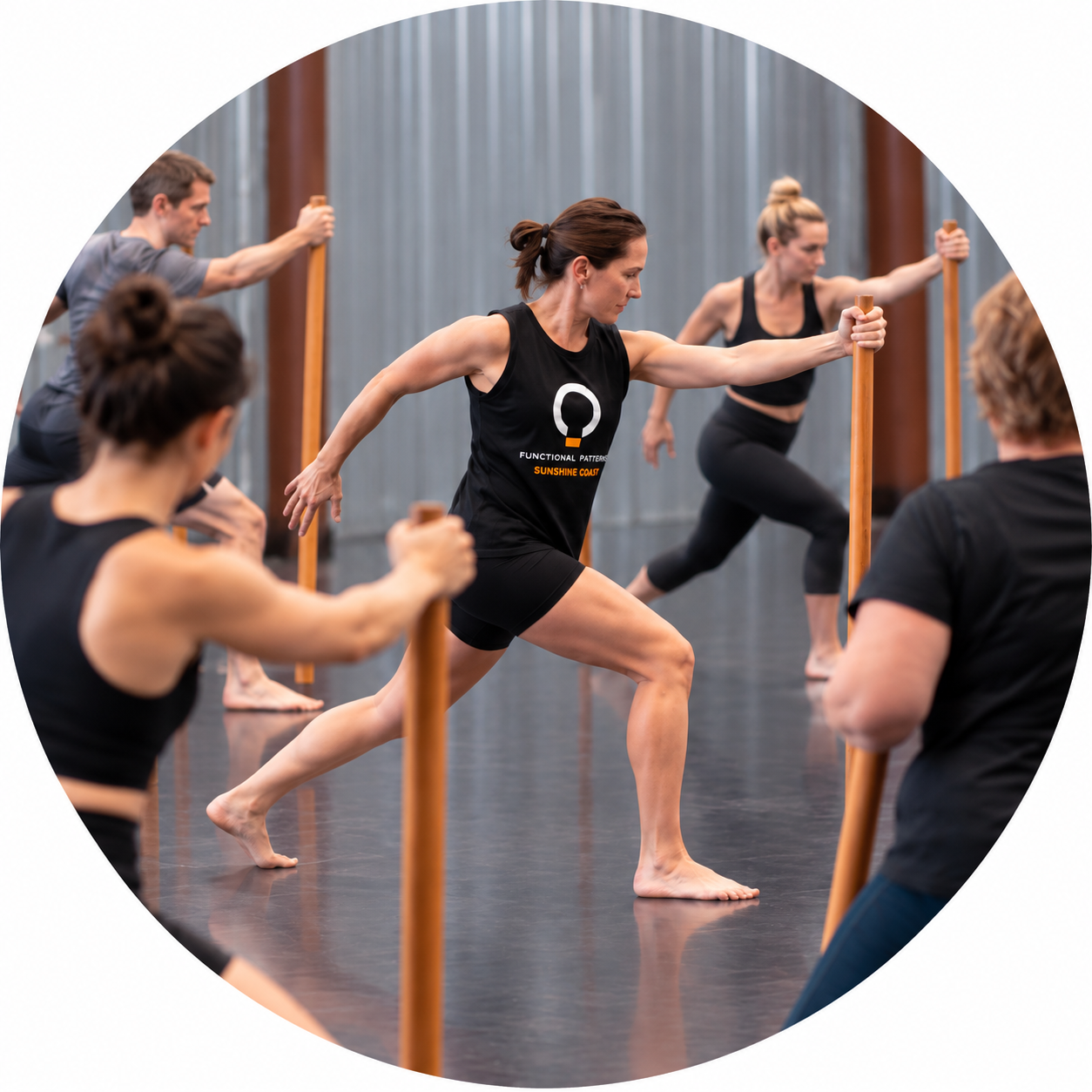
The short answer is: You usually need to improve the movement strategy of the whole body - not simply pull your head backwards or stretch your neck.
At Functional Patterns Sunshine Coast, we view posture as an expression of how the body has adapted to the movements and positions it repeatedly performs.
That means forward head posture is often better understood as part of a whole-body movement pattern, rather than an isolated neck problem.
What Is Forward Head Posture?
Forward head posture describes a position where the head translates forward relative to the torso. From the side, you may notice:
the ear sitting noticeably in front of the shoulder
the chin projecting forwards
increased rounding through the upper back
the shoulders sitting forwards
tension around the neck and upper shoulders
But the important question isn't simply: “Where is the head?”
It is: “Why has the body organised itself this way?”
That distinction matters. Because if you only try to force the head backwards without changing the movement strategy underneath it, the posture will often return.
What Causes Forward Head Posture?
There usually isn't one single cause. Forward head posture can emerge from the accumulated effect of repeated movement behaviours over time. Your body is constantly adapting to the demands placed upon it. Every time you sit, stand, walk, breathe, reach or train, your nervous system is reinforcing a particular movement strategy. If that strategy repeatedly places the ribcage, pelvis, shoulders and spine in positions that require the head to move forwards to maintain balance or visual orientation, the body can gradually become more efficient at holding that posture. Common influences may include:
prolonged sitting
screen use
poor ribcage and pelvic positioning
limited thoracic rotation
poor breathing mechanics
repetitive gym or work movements
reduced movement variability
old injuries or compensations
But rather than thinking of these as isolated “causes”, it is often more useful to think of them as repeated inputs that influence how the body adapts.
Is Forward Head Posture Just a Neck Problem?
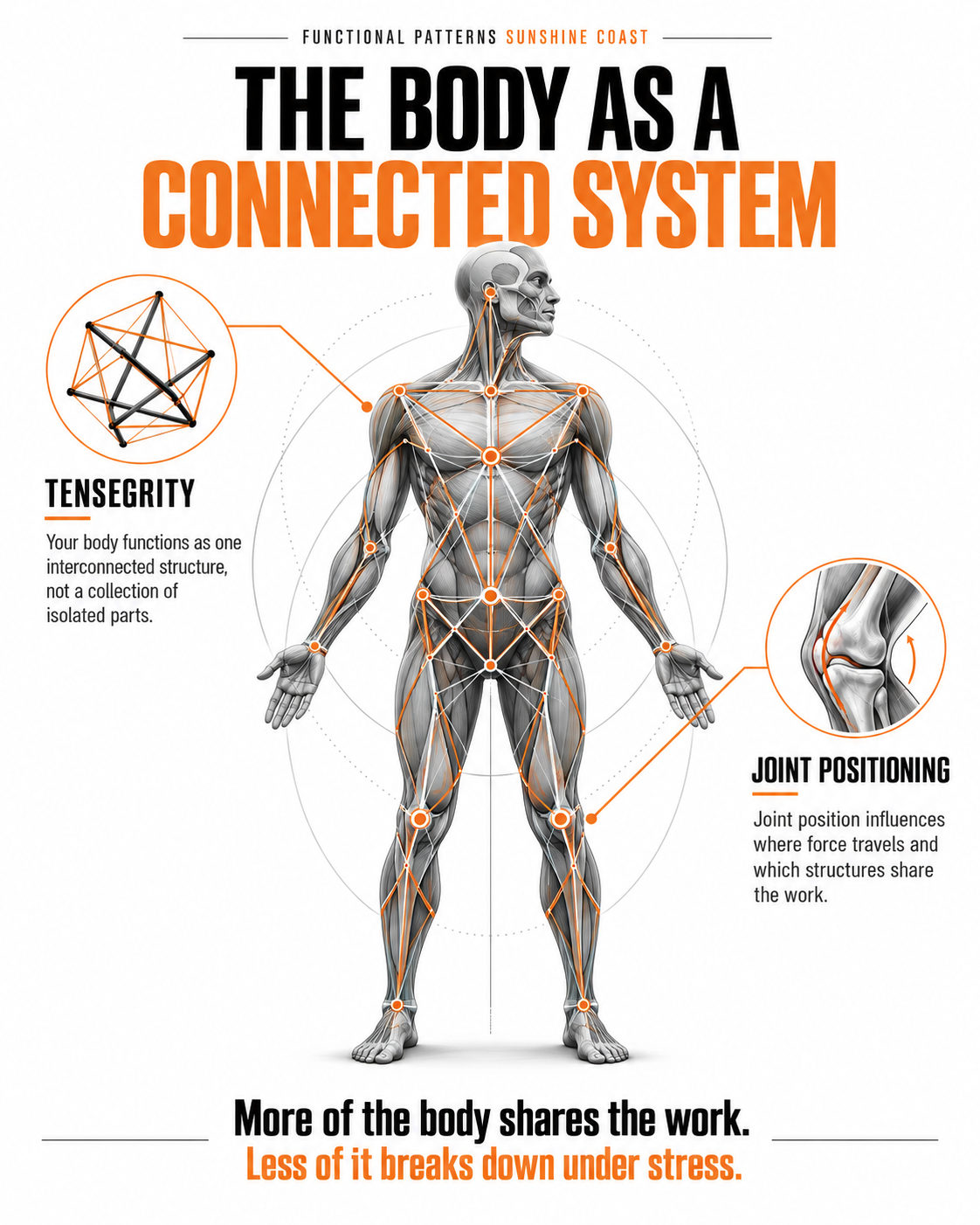
Usually not. The body functions as one connected system. Your head sits on your spine, which sits above your ribcage, which interacts with your pelvis, hips, legs and feet.
A change in one area can influence how another area positions itself. This is why the location of a postural change does not necessarily tell us where the driver is. For example, if the ribcage sits too far behind the pelvis, or the upper back cannot rotate and extend effectively during movement, the head may move forwards as part of the compensation. That forward head position may therefore be a solution the body has found, rather than the original problem. This idea is central to how we assess movement at Functional Patterns Sunshine Coast. The body doesn't move as separate muscles and joints; it operates as one interconnected structure.
Why Does Forward Head Posture Develop?
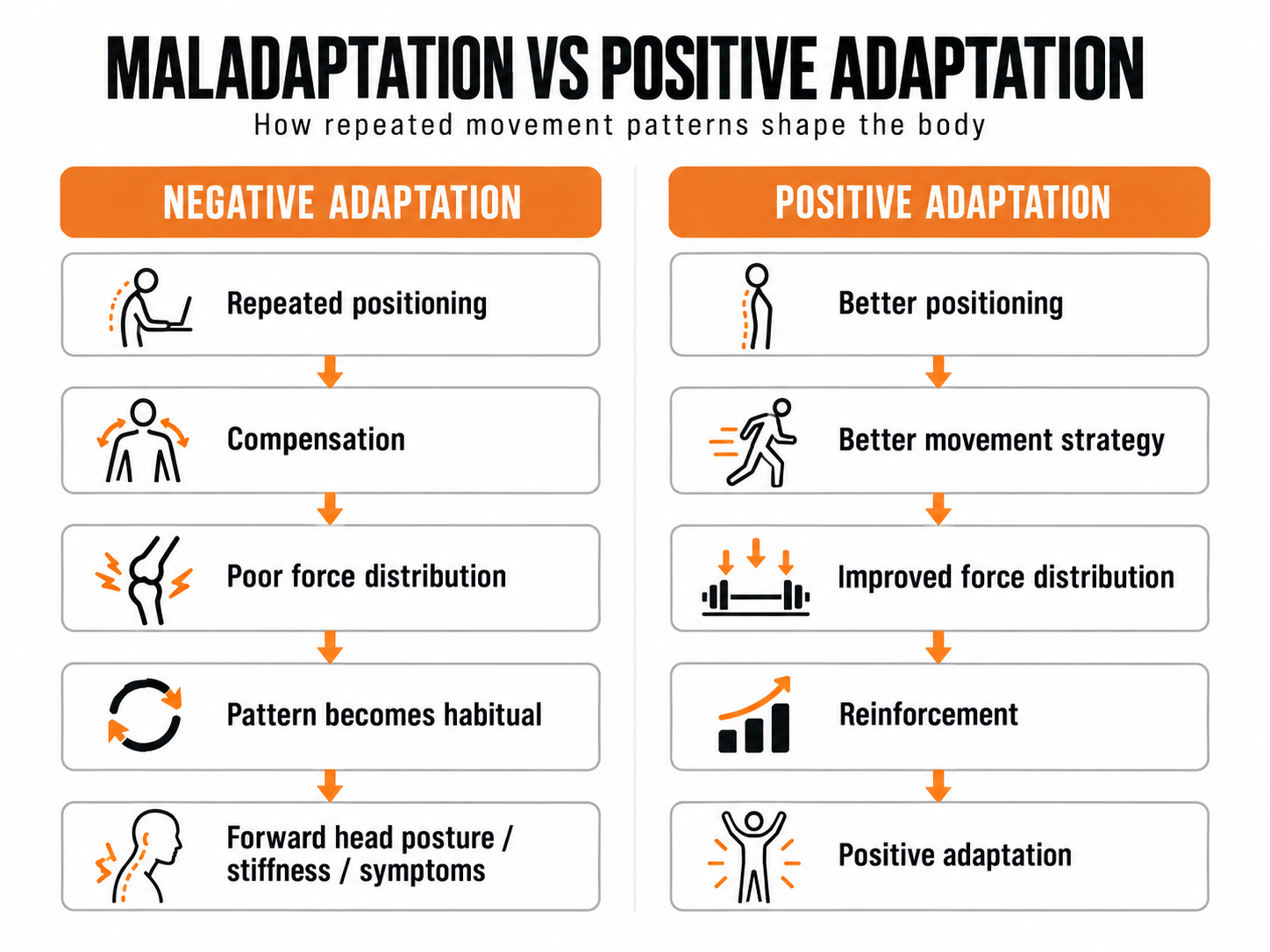
To understand this, it helps to understand adaptation. Your body becomes increasingly efficient at whatever behaviours you repeat most often - whether those behaviours are useful or not.
If your body repeatedly uses a strategy involving: poor joint positioning → reduced force distribution → compensation → repetition… that strategy can gradually become your default. This is what we refer to as maladaptation.
A compensation can initially be useful. It helps the body keep functioning despite limitations elsewhere. The issue arises when that compensation becomes heavily reinforced over months or years. At that point, what started as a workaround can become the very thing limiting movement.
Does Forward Head Posture Cause Neck Pain?
Not necessarily. Some people have noticeable forward head posture with very few symptoms. Other people have relatively subtle postural changes and significant pain.
So posture alone should not be treated as a diagnosis. However, an inefficient postural strategy can have a huge influence how forces are distributed through the neck, shoulders and upper body. When certain tissues repeatedly absorb more load than they are well positioned to handle, symptoms can emerge over time.
This is why we are interested in how the person moves, not merely whether their head looks forward in a still photo.
Why Stretching Your Neck Often Isn't Enough.
One of the most common approaches to forward head posture is to stretch the tight muscles and strengthen the weak ones. While that can sometimes provide relief, it misses the reason those muscles became tight or weak in the first place. If the body's movement strategy remains unchanged, the same forces keep being reproduced.
At Functional Patterns Sunshine Coast, we make this distinction directly: weakness and tightness are often signs of a movement dysfunction rather than the root cause, and treating them in isolation may only create temporary change if the underlying pattern stays the same.
So rather than asking: “Which muscle do I stretch?”
a more useful question is: “What movement strategy is repeatedly putting my head, ribcage and shoulders in this position?”
Should I Just Pull My Chin Back?
Chin tucks are commonly prescribed for forward head posture. They may be useful in some contexts. But repeatedly forcing the chin backwards does not necessarily teach the body to organise itself better during standing, walking, running or everyday movement. This is particularly true if you already hold your head in a retracted position.
If your pelvis, ribcage and shoulders remain in the same positions, the neck may simply be asked to compensate differently. The goal should not be to create an artificially “perfect” static posture. The goal is to help the body naturally organise itself more efficiently.
What Does Better Posture Actually Mean?
Better posture is not as simple as “standing rigidly upright”. It is the ability for the body to distribute force efficiently while remaining adaptable. At Functional Patterns, we use fundamental human movement as the reference point.
Standing, walking, running and throwing form what we call the FP First Four.
When you look at people who move exceptionally well, several common characteristics appear:
force transfers efficiently through the whole body
the upper and lower body coordinate together
no single area has to absorb all of the load
movement remains controlled under demand
body segments sequence effectively
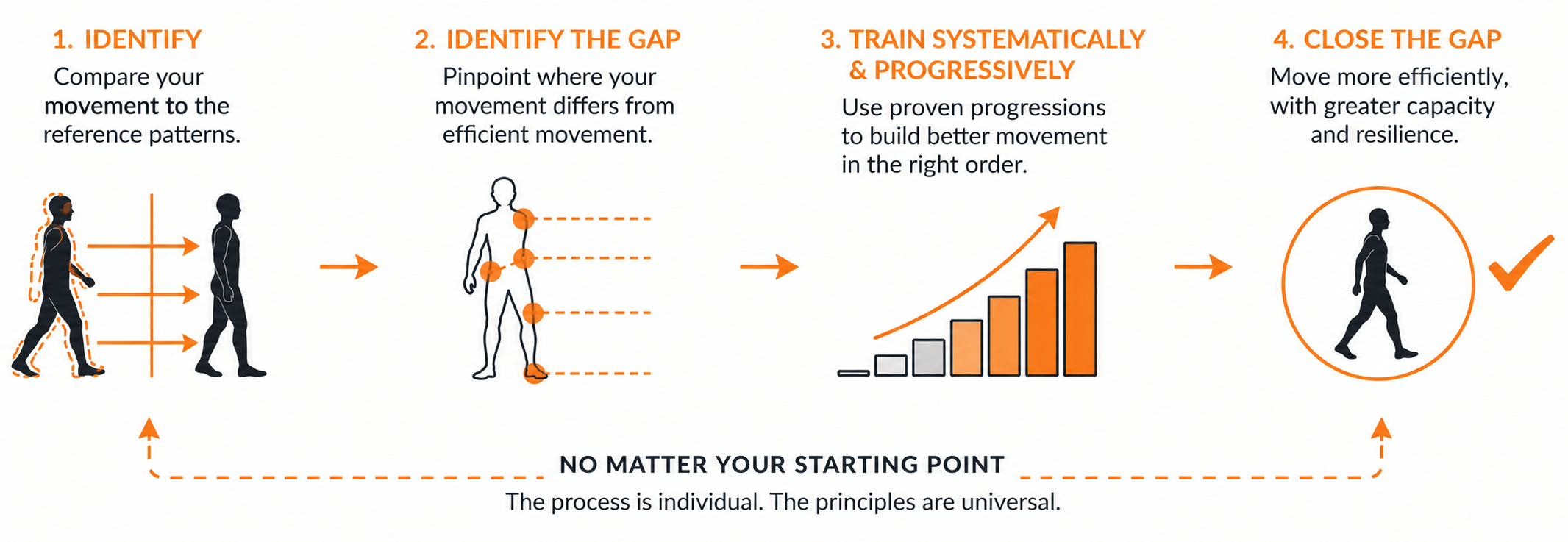
The aim isn't to turn someone with neck pain into an elite athlete. It is to use efficient movement as a reference point so we can identify where their current strategy differs and progressively close that gap.
How Do You Actually Improve Forward Head Posture?
There is no universal exercise that fixes every case. The starting point is understanding why your body is using the posture it currently uses. At Functional Patterns Sunshine Coast, the general process is:
1. Identify the movement strategy - We assess how you stand and move, including how your:
feet interact with the ground
pelvis positions and rotates
ribcage moves
shoulders coordinate
spine rotates
head and neck organise themselves
The goal is to identify the areas where movement efficiency is being lost.
2. Improve positioning - We then work to create better relationships between the major parts of the body. This can include improving:
pelvic positioning
ribcage mechanics
thoracic movement
scapular function
weight transfer
breathing mechanics
rotational coordination
3. Reinforce the improved strategy - A better position needs repetition. One good repetition will not override years of habitual movement. The new movement strategy must be repeated, loaded and progressively challenged.
4. Allow the body to adapt - Over time, the nervous system becomes more familiar with the new strategy and the body begins to organise around it. This is the same Identify → Reposition → Reinforce → Adapt model used throughout Functional Patterns.
What Exercises Fix Forward Head Posture?
There is no single exercise that fixes forward head posture in everyone. That answer is less satisfying than a list of five exercises - but it is much more accurate. The best exercise depends on:
what is driving the posture
how the pelvis and ribcage are positioned
how the person transfers weight
whether the spine rotates effectively
how the shoulders and arms coordinate
what movement patterns are being reinforced outside training
Two people can look very similar from the side while using completely different movement strategies. That means the appropriate exercise for one may be ineffective for another. This is why an assessment matters.
Can Walking Affect Forward Head Posture?
Absolutely. Walking is one of the highest-volume movements humans perform. If your walking mechanics repeatedly reinforce poor rotation, poor weight transfer or inefficient ribcage and pelvic positioning, those repetitions accumulate.
Remember: Your body becomes good at what it repeatedly practises.
Someone might perform three excellent corrective exercises for ten minutes, then spend the rest of the day reinforcing the same old movement strategy. The repetition count matters. That is why Functional Patterns places such a strong emphasis on walking and other fundamental human movement patterns rather than only isolated corrective exercises.
Can Gym Training Make Forward Head Posture Worse?
Any exercise can reinforce the movement strategy used to perform it. If someone already has an inefficient movement pattern and then loads that same pattern repeatedly with:
heavy pressing
rowing
squatting
cycling
bodybuilding
machine-based training
the body may simply become stronger at compensating. This is why more exercise does not always mean faster improvement. Quality of movement matters.
One precise repetition can reinforce a better strategy, while hundreds of poorly organised repetitions may strengthen the pattern you're trying to change.
How Long Does It Take to Correct Forward Head Posture?
There is no fixed timeline. It depends on factors including:
how long the pattern has existed
how strongly it is reinforced day to day
injury history
training history
movement awareness
consistency
sleep and recovery
how frequently better movement is practised
A posture that has been reinforced for 15 or 20 years is unlikely to completely reorganise in a week. Meaningful change usually comes from consistently tipping the balance toward the movement strategy you want to keep. That is why we focus more on the overall direction of change than chasing a quick visual correction.
What Progress Should You Look For?
Posture change is only one measure. Early improvements might include:
better awareness of your position
easier rotation
improved control
movements feeling less awkward
better coordination
improved breathing
Later changes may include:
reduced neck or shoulder stiffness
less pain
improved head and ribcage positioning
easier walking
better balance
greater resilience under load
This reflects a broader principle: meaningful movement improvement often begins before symptoms noticeably change.
Not Sure What's Driving Your Forward Head Posture?
At Functional Patterns Sunshine Coast, we assess how your entire body moves - not just where your head sits.
Your initial assessment helps us identify the movement strategies contributing to your posture and determine where the biggest opportunities for change are.
Functional Patterns Sunshine Coast — biomechanics-based training for posture, pain and movement on the Sunshine Coast.
FREQUENTLY ASKED QUESTIONS
-
Yes, posture can change because the body is adaptable. How much and how quickly it changes depends on the individual, the movement strategy involved and how consistently better movement behaviours are reinforced. This is what we do and regularly showcase at Functional Patterns Sunshine Coast.
-
There is no universal muscle pattern. Some muscles may appear weak or tight, but these findings often reflect the body's overall movement strategy rather than being the root cause themselves. You need to zoom out at look at the body as a whole.
-
They may help some people, but they do not address every cause of forward head posture. If the pelvis, ribcage and shoulders remain poorly organised, changing the neck alone may have limited effect, and could even have a negative impact in many cases.
-
Neck and upper-body mechanics can contribute to headaches in many people, though headaches have many possible causes. Persistent or unusual headaches should be medically assessed, before working on your movement capacity.
-
It significantly contributes to how load is distributed around the neck, and therefore posture can have a direct impact on pain.
-
Sleeping position may contribute to neck comfort and repeated positioning, but forward head posture is usually better understood as the result of many repeated behaviours rather than one factor alone.
-
No. The body remains adaptable. Long-standing patterns can take time to change, but movement and posture can improve with appropriately targeted training and repetition. If you change nothing, forward head posture will further be entrenched. If you change how you move, you can adapt your way out of a forward head posture (and into any other posture for that matter).