

QUICK ANSWER: Hip pain, poor posture and recurring injuries aren't always problems isolated to one body part. Your body's biomechanics, movement patterns and ability to distribute forces influence how individual joints and muscles function. At Functional Patterns Sunshine Coast, we assess the whole-body movement system to identify opportunities to improve posture, movement and physical capacity through specialised personal training.
Why Does Hip Pain Develop?
Hip pain is one of the most common complaints affecting people's ability to move comfortably. It can interfere with walking, running, climbing stairs, getting out of a chair, standing for extended periods or even sleeping. For some people, discomfort develops gradually. For others, it appears following an injury, an increase in physical activity or years of repeated movement habits.
Many people respond by searching for hip pain exercises, stretches, strengthening programs or a personal trainer who can help them get moving again. These can all be reasonable starting points, but there's an important consideration that is often overlooked. The hip doesn't operate independently.
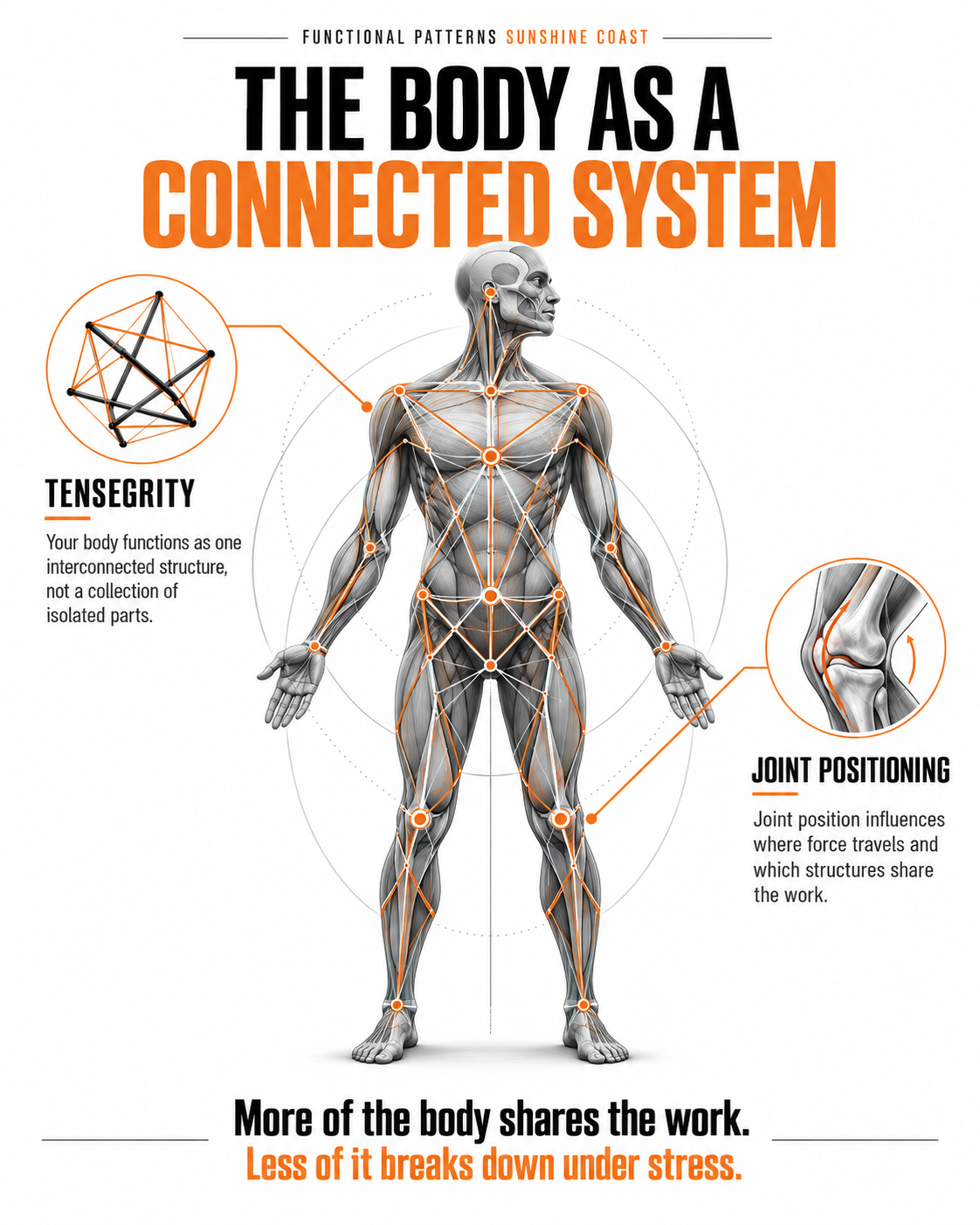
Its function is influenced by the positioning and coordination of the pelvis, spine, ribcage, knees, ankles and feet. These structures work together to distribute forces throughout the body during everyday activities. This is where biomechanics becomes important.
Biomechanics is concerned with how the body moves and manages physical forces. Understanding these relationships can provide valuable insight into why certain structures experience greater demands and why particular movement patterns may contribute to recurring discomfort.
Is Hip Pain Always a Hip Problem?
Not necessarily. Pain is experienced locally, but the factors contributing to it can involve a much larger movement system.
Consider walking. Every step requires your body to coordinate multiple structures. Your foot interacts with the ground, your lower leg manages the resulting forces, your pelvis and hips contribute to transferring those forces, and your trunk helps maintain balance and forward movement. These actions need to work together.
If the coordination between these structures is inefficient, the hip may experience demands that are not being managed effectively by the rest of the body. This doesn't mean the hip itself is never the source of the problem. Joint injuries, osteoarthritis, tendon disorders and other local conditions can all contribute to hip pain. Rather, it means that focusing exclusively on the painful area can overlook important factors influencing how that area functions.
The same principle applies to many other complaints, including knee pain, lower back pain, shoulder pain and recurring muscle injuries. The location of discomfort tells us where symptoms are experienced. It doesn't necessarily explain everything contributing to them.
At Functional Patterns Sunshine Coast, our approach to biomechanics and personal training starts with understanding how the whole body functions together.
How Posture and Biomechanics Influence Hip Pain.
Posture is often discussed as though it simply means standing up straight or pulling your shoulders back. However, posture involves much more than how you look when standing still.
It reflects how your body positions itself in relation to gravity and how different structures coordinate to maintain balance and manage forces. Your posture also changes as you walk, run, bend, rotate and perform everyday activities. The positioning of your pelvis, ribcage and spine influences the mechanical relationships between your upper and lower body.
For example, someone experiencing recurring hip discomfort may demonstrate movement characteristics involving:
Pelvic positioning: How the pelvis is oriented and coordinated with the trunk and lower limbs.
Spinal mechanics: How the spine contributes to movement, stability and force distribution.
Ribcage positioning: How the upper body relates to the pelvis during movement.
Hip mechanics: How the hip joints contribute to weight transfer, rotation and movement.
Foot and ankle mechanics: How the body interacts with the ground and manages forces through the lower limbs.
Movement coordination: How effectively these structures work together during walking and other activities.
These relationships are interconnected. Changing one aspect of your posture or movement can influence how other structures contribute to a task.
This is why simply correcting one body part or strengthening one muscle group may not address the broader movement behaviours influencing your physical function.
At Functional Patterns Sunshine Coast, we assess posture as part of a dynamic movement system rather than treating it as an isolated static position.
How Walking Mechanics Influence Hip Pain and Recurring Injuries
Walking is something most people do thousands of times each day without consciously thinking about it. However, walking is a complex coordination task. Each step requires the body to manage ground reaction forces, maintain balance, transfer weight and generate forward movement. The hips play an important role in this process, but their function depends on the surrounding structures.
For example:
Foot and ankle mechanics: How the foot interacts with the ground influences how forces travel through the lower limb.
Knee positioning: The relationship between the foot, knee and hip influences how the leg manages load.
Pelvic movement: The pelvis needs to coordinate with the legs and trunk as weight transfers from one side to the other.
Trunk positioning: The orientation and movement of the upper body influence balance and how forces are distributed through the hips.
Rotational coordination: Walking requires coordinated rotation between the pelvis, trunk and limbs.
These relationships are not separate mechanical events. They form one continuous movement process. If your walking mechanics repeatedly place excessive demands on particular structures, those demands can accumulate over time. This may contribute to discomfort, reduced movement capacity or difficulty tolerating everyday physical activities.
This is also why assessing walking mechanics can provide valuable information when investigating persistent hip pain or recurring lower-limb injuries.
At Functional Patterns Sunshine Coast, walking is one of the fundamental human movements we use to understand how the body functions.
Why Strengthening Your Glutes Isn't Always the Answer.
One of the most common recommendations for hip pain is to strengthen the gluteal muscles. Exercises such as glute bridges, clamshells, lateral band walks and hip abductions are frequently prescribed to improve hip stability and strength. These exercises can have a place in an appropriate training program. However, strengthening a muscle doesn't automatically improve the way the body coordinates movement. A muscle can become stronger while the underlying movement pattern remains unchanged.
For example, someone might develop considerably stronger gluteal muscles through isolated exercises but continue to demonstrate inefficient pelvic positioning, poor coordination between the trunk and lower limbs, or difficulty transferring force through their body during walking.
The issue isn't necessarily that their glutes are weak. It may be that their body hasn't developed the coordination required to use its available strength effectively. This distinction is important when choosing a personal trainer or developing a training program to address recurring pain or movement limitations.
A good training approach should consider more than how much weight someone can lift or how many repetitions they can perform. It should consider how the body positions itself, coordinates movement and manages forces. The objective shouldn't simply be to make individual muscles stronger. It should be to improve how the entire system works together.
Strength becomes much more useful when it can be applied through efficient, coordinated movement.
Hip Tightness, Mobility and Stretching.
Another common response to hip pain is to stretch the area. People often describe their hips as tight, restricted or lacking mobility. They might spend considerable time stretching their hip flexors, glutes or surrounding muscles in an attempt to improve how their hips feel. Sometimes, this provides temporary relief.
However, tightness isn't always a simple indication that a muscle needs to be stretched. Muscle tension is also influenced by how the nervous system coordinates movement, how joints are positioned and how the body manages forces. If the body repeatedly relies on particular muscles or movement strategies to maintain stability, those muscles may remain under increased tension.
Stretching may temporarily change how the area feels, but it doesn't necessarily change the movement behaviours contributing to that tension. At Functional Patterns Sunshine Coast, we are interested in why the body is producing that tension in the first place. Rather than automatically trying to lengthen a muscle, we look at how the surrounding structures are positioned and coordinated, and whether the body has the movement capacity to distribute forces more effectively. Mobility is important, but it needs to exist within a coordinated and functional movement system.
How Functional Patterns Approaches Hip Pain, Posture and Biomechanics.
At Functional Patterns Sunshine Coast, we don't approach the body as a collection of individual muscles, joints or painful areas. We have one body. The hip is simply one part of an interconnected system that needs to coordinate movement, manage forces and adapt to the demands of everyday life.
Our approach is built around understanding how humans are designed to function, using four fundamental movement patterns:
Standing: Establishing the ability to manage bodyweight and maintain efficient positioning against gravity.
Walking: Developing coordinated weight transfer, balance and forward movement.
Running: Building the ability to manage and transfer greater forces at higher speeds.
Throwing: Developing rotational coordination and the ability to transfer force through the body.
These are known as the Functional Patterns First Four. They provide a framework for understanding how the body should organise itself across different movement demands. Rather than focusing exclusively on the painful hip, we assess how the entire body contributes to these fundamental functions.
Our process follows four key stages.
1. Identify
We begin by identifying the movement patterns and behaviours that may be contributing to the problem. This includes considering your history, symptoms, daily activities, physical demands and current movement capacity. We assess relevant aspects of posture, joint positioning, standing and walking mechanics, coordination and how your body manages different movement tasks. The goal is to understand what is happening throughout the system rather than making assumptions based solely on where you experience pain.
2. Reposition
Once we understand the relevant movement patterns, we begin working on improving positioning and coordination. This involves developing better relationships between the joints and structures that contribute to movement. The aim is to establish a more effective foundation for managing forces throughout the body.
3. Reinforce
Improved positioning needs to be reinforced through appropriate movement and training. We use specific exercises to develop coordination, control and the ability to produce and manage force. This isn't about performing as many repetitions as possible. It's about developing the quality of movement required to create meaningful improvements.
4. Adapt
Ultimately, improvements need to carry over into real life. Your body needs to become capable of managing the physical demands you place on it, whether that's walking, running, working, exercising or participating in sport. We progressively develop movement capacity so that improvements aren't limited to performing exercises inside a training facility. The objective is to build a body that functions more effectively across the demands of everyday life.
Why Repeated Movement Behaviours Matter.
Your body is constantly adapting to the demands placed upon it. The positions you spend time in, the movements you repeat, the activities you avoid and the way you distribute physical effort all contribute to how your body develops over time. These adaptations aren't necessarily beneficial.
If you repeatedly expose your body to movement patterns that distribute forces inefficiently, those patterns can become increasingly familiar and reinforced. Eventually, certain structures may be required to manage more demand than they are well equipped to tolerate. This is one reason why pain and injuries can become recurring problems, even when someone has tried different exercises, stretches or treatments.
The body may continue returning to the same movement behaviours that contributed to the problem. Sometimes, an important part of making progress is temporarily reducing or eliminating certain inputs that reinforce those behaviours.
Within Functional Patterns, this is known as the Movement Elimination Protocol. It isn't about stopping all physical activity or avoiding movement indefinitely. It's about strategically removing or reducing specific movement inputs to create an opportunity to establish more effective patterns before progressively reintroducing greater demands.
The intention is to change how the body manages movement, not simply to provide temporary relief.
Should You Stop Exercising If You Have Hip Pain?
Not necessarily. Completely avoiding movement isn't always the best approach to managing hip pain. Your body requires appropriate movement and physical activity to maintain its capacity. However, continuing to perform activities that consistently aggravate your symptoms without understanding why may not be productive either.
The important distinction is between movement that supports your current capacity and movement that exceeds what your body can comfortably manage. For example, someone experiencing hip pain might find that walking on flat ground is manageable but running, deep squatting or climbing stairs produces significant discomfort. This information can help guide decisions around training intensity, exercise selection and progression.
At Functional Patterns Sunshine Coast, we consider the individual's current capacity and work towards progressively developing more effective movement patterns. Training should have a purpose. Simply pushing through discomfort or repeatedly performing exercises without understanding their contribution to the overall movement system isn't a reliable strategy for long-term improvement.
What About Hip Osteoarthritis and Other Injuries?
Not all hip pain has the same underlying cause. Conditions such as hip osteoarthritis, labral injuries, tendon disorders, bursitis and other musculoskeletal conditions can contribute to pain and reduced function. These conditions may require specific medical assessment and management.
However, a diagnosis doesn't tell you everything about how someone's body moves or how effectively they manage physical demands. Two people with the same diagnosis can have very different movement patterns, physical capacities and experiences of pain.
This is why individual assessment matters. At Functional Patterns Sunshine Coast, we consider the person as a whole and work within the individual's capabilities, taking relevant diagnoses and medical advice into account.
Our focus is on improving the way the body moves, coordinates and manages physical demands - reducing the stress on specific body parts, and distributing across more of the structure.
What Makes Biomechanics-Based Personal Training Different?
Traditional personal training often focuses on developing strength, cardiovascular fitness, muscle mass or general physical conditioning. These are worthwhile training goals. However, if you're experiencing recurring pain, poor posture, repeated injuries or persistent movement limitations, you may need to look beyond general fitness. Biomechanics-based personal training places greater emphasis on understanding how the body positions itself, coordinates movement and distributes forces. Rather than simply selecting exercises to strengthen individual muscles, a biomechanics trainer considers how different parts of the body interact during fundamental human movements. At Functional Patterns Sunshine Coast, our practitioners use the Functional Patterns system to assess and train these relationships. Your training is individualised according to your movement patterns, history, goals and current capabilities. For someone experiencing hip pain, this means looking beyond the painful area and developing a structured approach to improving how the body functions as a whole.
The same approach can be relevant for people experiencing:
Persistent lower back, hip, knee or shoulder pain.
Recurring muscle strains and other movement-related injuries.
Poor posture or postural limitations.
Reduced balance and coordination.
Difficulty walking, running or performing everyday activities.
A history of repeated injuries despite previous exercise programs.
A desire to improve movement quality and long-term physical capacity.
The goal isn't simply to get stronger. It's to develop strength, coordination and physical capacity that transfer into everyday movement.
Common Hip Conditions Associated With Movement Dysfunction.
The way your body positions itself, coordinates movement and distributes physical forces can influence how different structures around the hip function. When these relationships aren't working effectively, certain tissues and structures may experience increased or repeated mechanical demands.Over time, these factors can contribute to pain, reduced movement capacity and aggravation of existing conditions.
Some commonly recognised hip conditions and presentations associated with these movement demands include:
Gluteal tendinopathy: Increased or poorly distributed loading demands around the lateral hip can influence the tolerance and function of the gluteal tendons.
Greater trochanteric pain syndrome (GTPS): Pelvic positioning, hip mechanics and loading strategies can influence compression and tensile demands around the outer hip.
Hip osteoarthritis: Changes in joint structure can influence movement capacity, while joint positioning and loading strategies may affect how the hip manages physical demands.
Femoroacetabular impingement (FAI): Hip joint morphology can influence available movement, while movement strategies and positioning may affect how symptoms present during particular activities.
Hip labral tears: Joint mechanics and loading demands can influence how the hip functions when the labrum is compromised.
Hip bursitis: Repeated mechanical irritation and compression around the hip can contribute to symptoms.
Hip flexor tendinopathy: Repeated loading demands and movement coordination can influence the capacity and tolerance of the hip flexor tendons.
Snapping hip syndrome: Movement coordination and the interaction between tendons and surrounding structures can contribute to snapping sensations during movement.
At Functional Patterns Sunshine Coast, we look beyond the individual diagnosis to understand how the entire body is positioned, coordinated and managing physical forces. Our focus is on improving movement patterns and developing greater physical capacity through biomechanics-based personal training.
Ready to get started?
If you're experiencing persistent hip pain, recurring injuries, poor posture or limitations in how you move, it may be time to look beyond the painful area and understand what's happening throughout your body.
At Functional Patterns Sunshine Coast, your initial consultation looks at your posture, walking mechanics, movement coordination and how your body manages physical demands. From there, we develop an individualised approach to rebuilding your movement patterns, improving your biomechanics and developing a stronger, more capable body.
Whether you're looking for a personal trainer who takes a deeper approach to movement or a biomechanics trainer to help you address recurring physical limitations, we're here to help you understand your body and work towards meaningful, long-term improvements.
CHEVALLUM, SUNSHINE COAST | QUEENSLAND
-
Posture can influence how your body positions itself and manages forces. The way your body coordinates movement, distributes load and adapts to repeated physical demands can be a key factor to hip pain.
-
Walking requires coordinated movement between your feet, ankles, knees, hips, pelvis and trunk. Changes in joint positioning, coordination or load distribution can contribute to discomfort. Local hip conditions can also cause pain during walking, so individual assessment is important.
-
Yes, a suitably qualified personal trainer working in the Functional patterns method can help develop strength, movement capacity and general physical conditioning. A biomechanics-based approach also considers posture, coordination and how the body distributes forces.
-
Glute strengthening may be useful, depending on the individual. However, isolated strength improvements don't necessarily address the movement patterns influencing hip function. A broader assessment can help determine how strengthening fits into an appropriate training approach.
-
Increased tension around the hip flexors can contribute to discomfort in some circumstances, but tightness doesn't automatically mean a muscle needs stretching. The surrounding joint positioning, muscle coordination and movement demands should also be considered.
-
Biomechanics-based training looks at how your body positions itself and coordinates movement. Rather than focusing exclusively on standing straighter, the aim is to develop better movement strategies and physical capacity that can carry over into everyday activities.
-
Functional Patterns takes a whole-body approach to movement, assessing how the body positions itself, coordinates movement and distributes forces. Training is individualised to develop movement quality and physical capacity.
-
There is no universal timeframe. Progress depends on the underlying factors contributing to the pain, the individual's starting point, physical capacity and consistency with an appropriate training approach. Meaningful changes in movement and function generally require progressive, sustained work.
-
Functional Patterns Sunshine Coast is based in Chevallum and works with clients from across the Sunshine Coast, including Buderim, Maroochydore, Nambour, Mooloolaba, Caloundra and surrounding areas. Our practitioners provide individualised biomechanics-based personal training focused on posture, movement, physical function and developing greater physical capacity.