

Quick answer: Does Ankle Mobility Affect Running? Ankle mobility and foot function influence how your body manages ground contact, distributes force and coordinates each running stride. However, having greater ankle mobility or a particular foot shape does not automatically improve running. What matters is how you use the movement available and how your feet, ankles and the rest of your body work together to meet the demands of running.
Do you feel stiff through your ankles when running? Perhaps your heels lift early during a squat, your feet feel unstable on uneven ground, or you have been told that limited ankle mobility is affecting your running technique.
Ankle mobility and foot function are important considerations in running, but having more movement available does not automatically mean you will run better. What matters is how your body uses the movement available to coordinate each stride, manage ground contact and transfer force throughout the body.
Running places unique demands on the relationship between your feet, ankles, legs and trunk. Each step requires your body to interact with the ground, manage the forces created during contact and transition into the next stride.
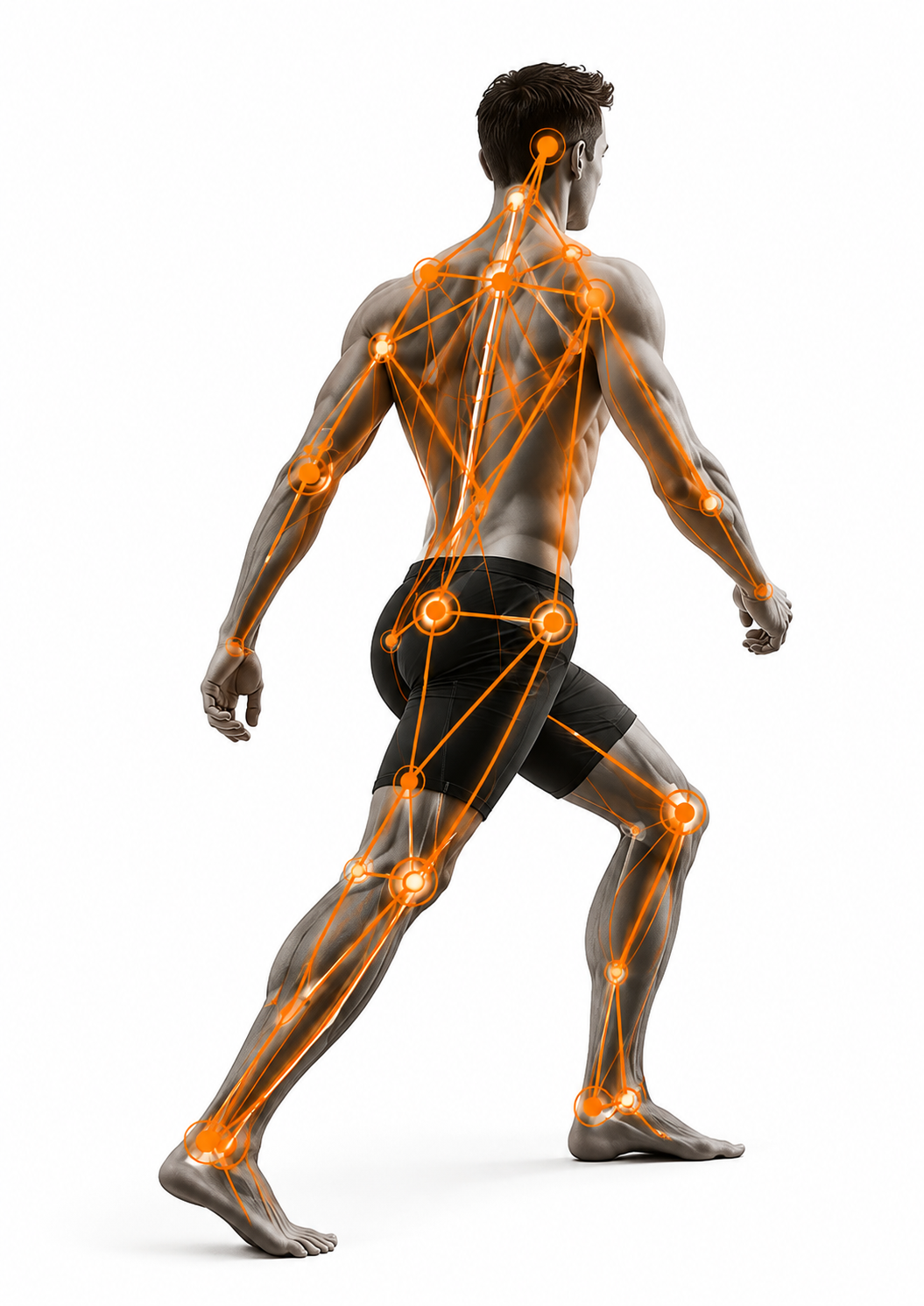
Understanding this relationship requires looking beyond how far your ankle can move or whether your foot has a particular arch shape.
What actually happens when your foot contacts the ground?
Every running stride begins with an interaction between your foot and the ground. As your body moves forward, your foot must accommodate contact, manage loading and contribute to the transition towards propulsion. This process involves several coordinated phases.
Initial contact
Your foot makes contact with the ground, establishing the starting point for managing the forces associated with that stride. The position of your foot at contact influences the subsequent movement of the ankle, lower leg and the rest of your body.
Weight acceptance
As your body progresses over the supporting foot, the ankle moves into dorsiflexion. This describes the movement that brings the top of the foot closer towards the shin. At the same time, the foot changes shape and the surrounding structures contribute to controlling and accommodating the load.
Propulsion
As your body progresses towards the next stride, the heel rises and the foot contributes to pushing against the ground. The timing and coordination of this transition influence how force is transferred through the lower limb and into the rest of the body. These phases are not isolated events. They are components of one continuous movement sequence.
A limitation in one aspect of this sequence may influence how the person organises the rest of the stride. Equally, the way the entire body moves can influence the demands placed on the foot and ankle. This is why assessing ankle mobility without considering running mechanics provides an incomplete picture.
Ankle mobility: Why more range isn't automatically better
One of the most common recommendations for runners is to improve ankle dorsiflexion. Dorsiflexion is important because it allows the lower leg to progress over the foot during weight-bearing activities.
For example, when walking downstairs or moving into a deeper squat, your body requires sufficient ankle movement to accommodate the task. Running involves a different combination of speed, loading and timing.
The amount of dorsiflexion available is only one consideration. We also need to understand:
Whether the available movement can be accessed under load.
How the lower leg progresses over the supporting foot.
Whether the heel rises at an appropriate point in the movement.
How the foot accommodates and redistributes loading.
Whether the movement is coordinated with the pelvis and trunk.
Whether the person's strategy changes as speed or fatigue increases.
Consider two runners with similar ankle mobility measurements.
One coordinates their stride comfortably, managing ground contact and transitioning smoothly into the next step. The other may demonstrate a different strategy, relying on a more restricted movement sequence or shifting more demand towards other structures.
The measurements alone cannot explain that difference.
There is also an important distinction between available range and usable movement. Being able to move further during a passive assessment does not necessarily mean you can control that range effectively while running.
The objective is not to maximise ankle mobility. It is to understand whether the available movement is appropriate for the demands being placed on the person.
Your foot is doing more than supporting your body weight
The foot is an adaptable structure that contributes to managing ground contact, accommodating changes in loading and transferring force during movement. Its arches, joints, connective tissues and muscles contribute to this process together. The arch, for example, is not simply a static structure that should remain rigid or collapse as little as possible.
During weight acceptance, the foot can accommodate loading through changes in its shape. As the person progresses towards propulsion, the foot contributes to a different mechanical task. This ability to accommodate and subsequently contribute to propulsion is an important part of running.
Problems arise when advice reduces foot function to a single characteristic.
You may have heard that:
High arches are better for running.
Flat feet automatically cause poor running mechanics.
Everyone should avoid pronation.
Barefoot running will strengthen your feet.
Arch-supporting shoes are necessary for everyone.
These statements overlook individual differences and the demands of the activity. Pronation, for example, is a normal component of foot movement. It contributes to how the foot accommodates contact with the ground. The presence of pronation does not automatically indicate dysfunction, just as a visibly high arch does not automatically indicate efficient movement. What matters is how the person manages loading and coordinates their movement under the demands of running.
Why the foot and ankle cannot be assessed in isolation
This is where the broader biomechanics of running becomes important. When your foot contacts the ground, the resulting forces do not remain confined to the foot. They interact with the ankle, lower leg, knee, thigh, pelvis and trunk as your body progresses through the stride. The timing and positioning of these structures influence how the entire person manages movement.
Consider running downhill. The demands of controlling forward movement and managing impact differ from running on flat ground. The body must coordinate braking, weight transfer and subsequent propulsion while adapting to the changing terrain. The foot and ankle contribute to this task, but the overall strategy also involves the positioning and movement of the pelvis, trunk and opposite leg.
Now consider someone running on a flat surface who has developed a habitual strategy involving relatively limited movement through the ankle and foot. Their body may find alternative ways to complete the stride. Those alternatives may be perfectly adequate at lower speeds but become more demanding as running volume or intensity increases.
This does not establish that restricted ankle movement causes injury. It illustrates why movement needs to be understood as an integrated task. Your body adapts to the movement behaviours you repeatedly practise. If a particular strategy is consistently reinforced, it can become increasingly familiar and automatic, even when it is not the most effective way to meet a particular physical demand.
What does research tell us about ankle mobility and running?
There is good biomechanical evidence that ankle movement and foot mechanics influence how running forces are managed. However, it is important to distinguish between demonstrating a mechanical difference and demonstrating that the difference causes injury.
For example, research comparing running foot-strike patterns has identified differences in ankle position, ankle movement and loading characteristics between rearfoot and forefoot runners. These findings demonstrate that changing how the foot contacts the ground changes the mechanics of the running stride. They do not establish that one foot-strike pattern is universally superior.
Similarly, a 2023 systematic review examining running biomechanics and injury found that the overall association between biomechanical variables and running-related injuries was weak. The researchers highlighted substantial variation between studies and limited evidence for many commonly discussed biomechanical predictors.
Research published in 2025 also examined individual assessment of ankle dorsiflexion restrictions in athletes. It highlighted the importance of distinguishing between different potential contributors to restricted movement rather than assuming every limitation requires the same intervention. However, its proposed clinical framework still requires stronger intervention evidence.
The practical takeaway is straightforward:
Ankle mobility, foot mechanics and running technique are relevant, but none should be interpreted without considering the person's individual movement strategy and physical demands.
What should you look for in your own running?
If you regularly run, there are a few observations that may help you understand how your movement is organised.
They are not diagnostic tests, but they can help identify questions worth exploring.
1. Does your ankle movement change under different conditions?
Notice whether running uphill, downhill or on flat ground changes how your foot contacts the ground or how your lower leg moves. Different terrain creates different demands. A movement strategy that works comfortably in one setting may become more difficult in another.
2. Does one side behave differently?
You may notice differences in how your left and right feet contact the ground, how your heels rise or how your body transfers weight between sides.
3. Does your movement change as you become fatigued?
Observe whether your stride changes towards the end of a run. For example, your foot contact, heel movement or coordination between your upper and lower body may become different as fatigue develops.
4. Does stretching actually change your running?
You might notice an improvement in ankle range after stretching, but that does not necessarily mean your running mechanics have changed for the better. The more important question is whether you can access and coordinate the movement during the activity itself.
A mirror or video recording can help reveal differences that are difficult to notice through sensation alone.
How Functional Patterns approaches foot and ankle mechanics
At Functional Patterns Sunshine Coast, we consider foot and ankle movement within the context of the entire person's movement.
The FP First Four provide our fundamental reference patterns:
Standing
Walking
Running
Throwing
Running is particularly useful because it requires repeated coordination between the upper and lower body while managing the changing forces created by ground contact.
An assessment may examine how someone distributes their weight, coordinates their stride, manages joint positioning and transfers force throughout the body.
Rather than automatically prescribing more ankle stretching or isolated foot strengthening, the objective is to understand what is actually happening during movement.
Our process follows four stages:
IDENTIFY → REPOSITION → REINFORCE → ADAPT
Identify: Understand the person's existing movement behaviours, including relevant limitations in foot and ankle mechanics.
Reposition: Work towards improved joint positioning, stability and coordination within the wider movement pattern.
Reinforce: Practise the improved movement strategy consistently, with appropriate progression and attention to movement quality.
Adapt: Allow time for the body to respond to repeated practice and progressively increased demands.
In some circumstances, a practitioner may recommend temporarily modifying an activity that repeatedly reinforces a movement strategy being changed. This is the Movement Elimination Protocol. It is individualised and targeted, not a blanket recommendation to stop running.
The goal is to improve how the person manages the demands of running, rather than simply increasing one measurement of ankle mobility.
Ready to Get Started?
An initial consultation at Functional Patterns Sunshine Coast considers your individual movement as an integrated system, including your history, goals, posture, walking and running mechanics, and coordination. This helps identify what may be limiting your movement and establish a starting point for improving how your body functions; click below to request your initial consultation and begin working towards better movement.
FREQUENTLY ASKED QUESTIONS
-
It can influence how your body manages ground contact and progresses through each stride. However, its relevance depends on the amount of movement available, your ability to use that movement under load and how you coordinate your overall running/movement mechanics.
-
Not necessarily. More range is not automatically better. The important consideration is whether the available movement meets the demands of your activities and this should be achieved with strength, control and range, rather than just chasing range in isolation as this comes with many trade-offs.
-
No. Flat feet do not automatically indicate poor running mechanics or an increased risk of injury. Foot structure varies between individuals, and pronation is a normal part of foot movement. How someone manages loading and coordinates their movement is more informative than arch height alone.
-
It is context specific - depending on the speed of running, jogging, or walking, especially when considering the rest of the kinetic chain (whole body) and how this relates to the foot and ankle.
-
Foot strengthening can contribute to physical capacity, but strength alone does not guarantee better running mechanics. Running requires the coordinated use of the entire body, so improvements in strength should transfer into the movement task itself.
-
An individual assessment can examine ankle range, movement under load, foot mechanics and running coordination. Comparing these findings with your history and actual running demands provides a more useful picture than relying on a single mobility test.